









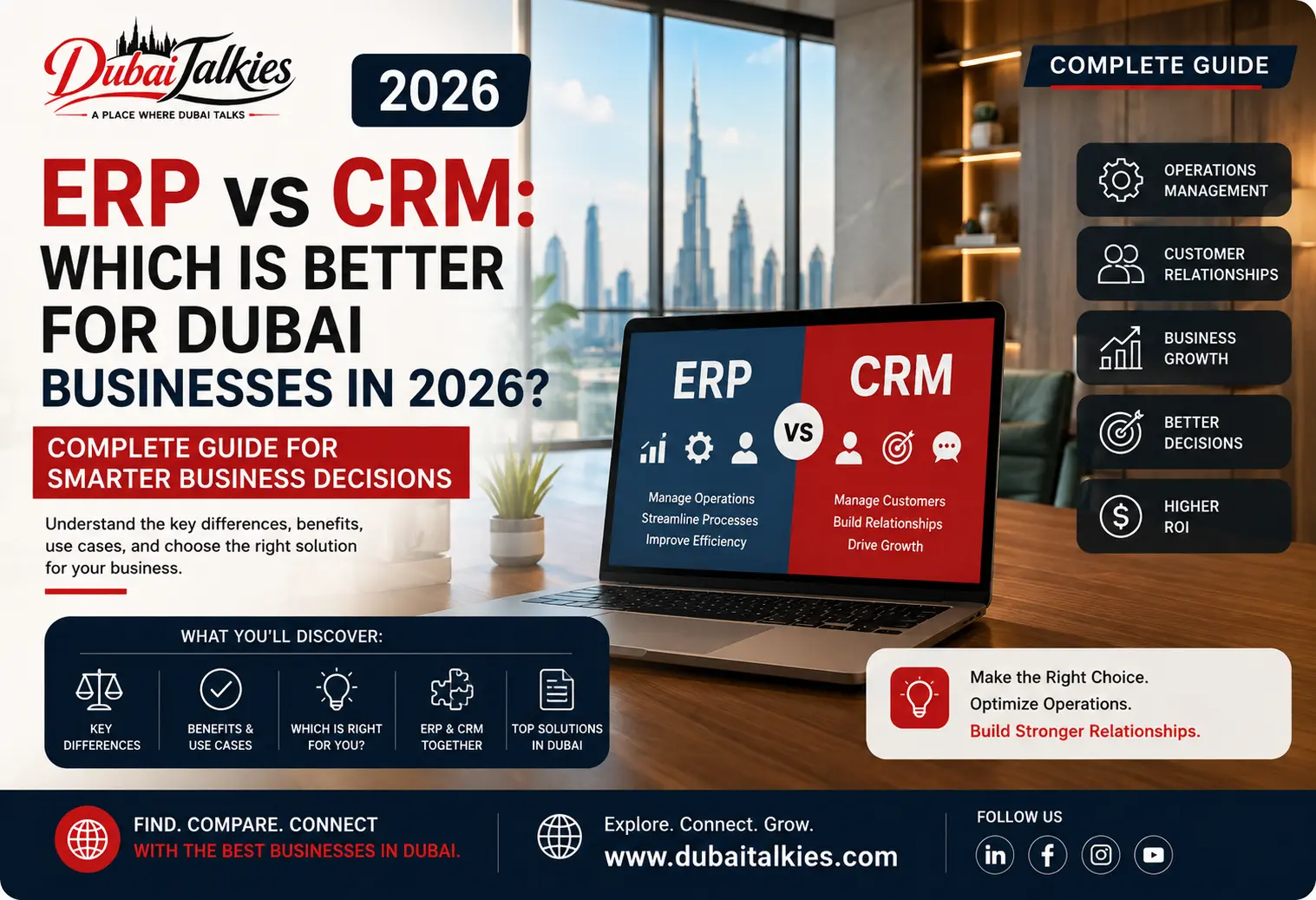
Running a business in Dubai has become increasingly competitive. Companies across industries are investing in technology to improve efficiency, reduce operational costs, and deliver better customer experiences. Alongside adopting business software, maintaining a strong digital presence is equally important for attracting customers and staying ahead of competitors.
Among the most commonly discussed business software solutions are Enterprise Resource Planning (ERP) systems and Customer Relationship Management (CRM) software. Many business owners also rely on professional business profiles to showcase their services, build credibility, and generate qualified leads online.
Many business owners often ask whether they should invest in ERP, CRM, or both. While these systems may appear similar at first glance, they serve completely different purposes within an organisation. Choosing the right solution depends on your business goals, operational requirements, customer management strategy, and future growth plans. Businesses that combine the right technology with effective online business visibility are often better positioned for long-term success.
Whether you own a startup, SME, or enterprise in Dubai, understanding the difference between ERP and CRM can help you make informed technology decisions that support long-term business success. If you're looking to increase your company's visibility, attract new customers, and establish a trusted digital identity, creating a business profile on Dubaitalkies can help your business connect with a growing community of professionals and customers across Dubai.
What Is an ERP System?
Enterprise Resource Planning (ERP) is a business management software that integrates multiple departments into a single centralised platform. Instead of using separate software for accounting, inventory, purchasing, human resources, and finance, an ERP system allows businesses to manage all these operations from a single, unified system.
An ERP platform focuses on improving internal business processes. It helps companies automate repetitive tasks, maintain accurate business records, streamline workflows, and improve collaboration between departments.
For businesses operating in Dubai, ERP systems are particularly useful because they simplify financial reporting, inventory management, VAT compliance, procurement processes, and resource planning.
Modern ERP solutions are commonly used by manufacturing companies, logistics providers, construction firms, wholesalers, retailers, healthcare organisations, and large service businesses.
What Is CRM Software?
Customer Relationship Management (CRM) software is designed specifically to manage customer interactions throughout the entire sales journey.
Unlike ERP, which focuses on internal operations, CRM focuses on customers.
A CRM system enables businesses to organise customer information, track leads, manage sales opportunities, automate follow-ups, record communication history, and improve customer service.
Businesses use CRM software to understand customer behaviour, build stronger relationships, improve sales conversion rates, and increase customer retention.
In Dubai's highly competitive business environment, where acquiring new customers is becoming more expensive, CRM software plays a critical role in helping businesses generate qualified leads and maintain long-term relationships.
Why Dubai Businesses Are Investing in Business Management Software
Dubai continues to attract startups, SMEs, multinational corporations, and international investors. As competition increases, businesses are under constant pressure to improve efficiency while maintaining exceptional customer experiences.
Manual processes often result in:
Lost customer inquiries
Delayed follow-ups
Duplicate records
Inventory errors
Financial reporting mistakes
Poor communication between departments
Business management software helps eliminate these operational challenges by automating workflows and providing real-time business insights.
Companies that adopt ERP or CRM systems can make faster decisions, improve productivity, reduce operational costs, and scale more efficiently.
ERP vs CRM: Understanding the Core Difference
Although ERP and CRM systems can work together, their primary objectives are different.
ERP manages the internal functioning of a business, including finance, inventory, procurement, operations, human resources, and production.
CRM manages external relationships by helping businesses attract, engage, convert, and retain customers.
Think of ERP as software that keeps your company running efficiently behind the scenes, while CRM helps your sales and marketing teams build stronger customer relationships.
Understanding this distinction is essential before investing in either solution.
Which Departments Use ERP?
ERP software supports multiple departments across an organisation.
Finance teams use ERP to manage accounting, budgeting, tax reporting, invoicing, and financial analysis.
Inventory managers monitor stock levels, warehouse movements, and procurement activities.
Human resources departments handle employee records, payroll, attendance, and recruitment.
Operations teams use ERP to improve workflow management and production planning.
Procurement departments track suppliers, purchase orders, and inventory replenishment.
Since all departments access the same centralised database, businesses benefit from greater accuracy and improved collaboration.
Which Teams Benefit Most from CRM?
CRM software primarily supports customer-facing teams.
Sales representatives use CRM to manage leads, monitor sales pipelines, schedule follow-ups, and close deals more efficiently.
Marketing teams analyse campaign performance, segment customer audiences, and automate communication.
Customer service teams access complete customer histories, enabling faster issue resolution and better support experiences.
Business owners also benefit from CRM dashboards that provide real-time visibility into sales performance, lead generation, and customer engagement.
For businesses focused on increasing revenue and improving customer satisfaction, CRM becomes an essential business tool.
Why Many Growing Businesses Eventually Need Both
As businesses expand, internal operations become more complex while customer interactions also increase.
Managing operations without ERP may create inefficiencies, while managing customer relationships without CRM may lead to lost business opportunities.
Many medium-sized and enterprise businesses eventually integrate ERP and CRM systems to achieve complete visibility across both operations and customer management.
When both systems work together, sales teams can view inventory availability, finance departments can access customer payment histories, and management can make data-driven decisions using information from every department.
For growing businesses in Dubai, combining ERP and CRM often creates a stronger foundation for sustainable expansion.
Can Small Businesses Use CRM Without ERP?
Absolutely. In fact, many startups and small businesses begin with a CRM before investing in an ERP system.
When a business is focused on attracting customers, generating leads, managing inquiries, and increasing sales, CRM provides immediate value. It allows business owners to organise customer information, schedule follow-ups, automate reminders, and monitor sales opportunities from a single dashboard.
For many SMEs in Dubai, CRM is often the first technology investment because customer acquisition directly impacts revenue growth.
As operations become more complex with increasing numbers of employees, inventory, finance, procurement, and internal processes, businesses can later adopt an ERP solution to improve operational efficiency.
Can ERP Work Without CRM?
Yes, but businesses may miss valuable opportunities to improve customer relationships.
An ERP system can efficiently manage inventory, finance, payroll, procurement, and operations, but it does not provide advanced customer relationship capabilities.
Without CRM, sales teams may struggle to track leads, monitor customer interactions, follow up consistently, or analyse customer behaviour.
This can result in slower sales cycles and missed business opportunities.
For companies that prioritise customer acquisition and long-term client relationships, CRM complements ERP by providing a complete view of the customer journey.
Industries That Benefit Most from ERP
ERP solutions are particularly valuable for businesses with complex operational requirements.
Manufacturing companies rely on ERP to manage production planning, inventory, procurement, and supplier relationships.
Construction companies use ERP to monitor projects, equipment, budgets, and workforce management.
Healthcare organisations benefit from ERP by improving resource planning and financial management.
Retailers and wholesalers manage inventory, warehouses, suppliers, and purchase orders more effectively through ERP systems.
Logistics companies use ERP to coordinate transportation, warehousing, procurement, and financial operations.
As organisations grow larger, ERP becomes increasingly important for maintaining operational efficiency.
Industries That Benefit Most from CRM
CRM software delivers the greatest value to businesses that rely heavily on customer interactions.
Real estate agencies use CRM to manage property inquiries, schedule follow-ups, and track buyers.
Digital marketing agencies organise client communications, campaigns, and project updates.
IT companies manage sales pipelines and enterprise accounts through CRM platforms.
Professional consultants maintain detailed client histories and appointment schedules.
Insurance companies, education providers, healthcare clinics, financial advisors, recruitment firms, and corporate service providers all benefit from structured customer relationship management.
Any business that depends on leads, inquiries, appointments, or repeat customers can significantly improve performance using CRM software.
How Dubai Businesses Should Choose Between ERP and CRM
Choosing the right system begins by understanding your current business priorities.
If your biggest challenge is managing customers, increasing inquiries, improving sales conversions, or maintaining long-term client relationships, CRM is usually the better investment.
If your business struggles with inventory, finance, procurement, payroll, operations, or internal coordination, ERP provides greater operational control.
Businesses should also consider company size, employee count, annual revenue, future expansion plans, and available budget before making a decision.
Technology should solve existing business problems rather than simply follow industry trends.
Signs Your Business Needs a CRM
Many businesses begin experiencing operational challenges that indicate it's time to adopt CRM software.
You may need a CRM if customer inquiries are frequently missed, follow-ups become inconsistent, or sales opportunities are difficult to track.
Businesses that store customer information across spreadsheets, emails, and messaging apps often lose valuable sales data.
If multiple sales representatives communicate with the same customer without proper coordination, CRM can centralise every interaction and improve efficiency.
Growing businesses that want predictable lead generation and improved customer retention often find CRM to be one of the highest-return investments.
Signs Your Business Needs an ERP
Businesses typically require ERP when internal operations become increasingly difficult to manage.
Common signs include inventory discrepancies, delayed financial reporting, disconnected software systems, procurement inefficiencies, duplicate data entry, and poor collaboration between departments.
If different teams use separate software for accounting, inventory, HR, and purchasing, ERP can unify these processes into one integrated platform.
As organisations grow, operational complexity increases, making ERP an essential tool for scalability.
The Future of ERP and CRM in Dubai
Dubai continues to position itself as one of the world's leading digital economies.
Businesses are rapidly adopting cloud-based technologies, artificial intelligence, automation, predictive analytics, and integrated business management platforms.
Modern ERP and CRM solutions increasingly include AI-powered recommendations, workflow automation, advanced reporting, and real-time business intelligence.
Companies that invest in digital transformation today are likely to remain more competitive as customer expectations and business operations continue evolving.
Final Thoughts
ERP and CRM are not competing technologies—they solve different business challenges.
ERP helps businesses improve operational efficiency by managing internal processes such as finance, inventory, procurement, and human resources.
CRM focuses on customer acquisition, relationship management, sales growth, and long-term customer engagement.
For many startups and SMEs in Dubai, CRM is the logical first investment because it directly supports business growth through better customer management.
As businesses expand, integrating ERP with CRM creates a powerful ecosystem that connects operations, sales, marketing, and customer service into one streamlined workflow.
The right technology should always align with your business goals, current challenges, and future growth strategy.
Businesses looking to strengthen their digital presence, improve visibility, and connect with more customers can also benefit from creating a professional business profile on Dubaitalkies, helping them showcase their products, services, and expertise to a growing business community across Dubai.
FAQs
What is the difference between ERP and CRM?
ERP (Enterprise Resource Planning) helps businesses manage internal operations such as finance, inventory, procurement, HR, and accounting. CRM (Customer Relationship Management) focuses on managing customer interactions, sales, leads, marketing, and customer service.
Which is better for small businesses in Dubai: ERP or CRM?
For most startups and SMEs in Dubai, CRM is usually the better starting point because it helps generate leads, improve customer relationships, and increase sales. ERP becomes more valuable as business operations grow more complex.
Can a business use both ERP and CRM together?
Yes. Many medium-sized and enterprise businesses integrate ERP and CRM systems to manage both internal operations and customer relationships efficiently. Together, they provide complete visibility across the organisation.
Is CRM only for sales teams?
No. While sales teams are the primary users, marketing, customer support, management, and business owners also use CRM to improve customer engagement, monitor performance, and increase customer retention.
Which industries benefit the most from ERP?
ERP is widely used by manufacturing companies, logistics providers, construction firms, retailers, wholesalers, healthcare organisations, and businesses that manage inventory, procurement, finance, and operations.
Which industries benefit the most from CRM?
CRM is ideal for real estate agencies, digital marketing companies, IT firms, recruitment agencies, healthcare providers, educational institutions, financial consultants, insurance companies, and any business that relies on customer inquiries and lead management.
How do I know if my business needs CRM?
If your business struggles with lead management, customer follow-ups, sales tracking, or customer communication, implementing a CRM can significantly improve efficiency and revenue generation.
How do I know if my business needs ERP?
If your business experiences inventory issues, disconnected departments, financial reporting challenges, procurement inefficiencies, or operational bottlenecks, an ERP system can help streamline internal processes.
Can ERP replace CRM?
No. ERP and CRM serve different purposes. ERP manages internal business operations, while CRM focuses on customer acquisition, relationship management, and sales growth.
How can Dubaitalkies help businesses improve their online presence?
Dubaitalkies enables businesses to create professional business profiles, showcase their products and services, improve digital visibility, connect with potential customers, and become part of a growing business community across Dubai.
Weekly trending



Dubai's Culinary Delights: A Journey Through Flavors
November 18, 2025Activities,Food


Popular tags
Popular in dubai







Comments
No comments yet. Be the first to comment!