
Biryani
September 9, 2026


© Dubai Talkies. All rights reserved by zubaaly management LLC.
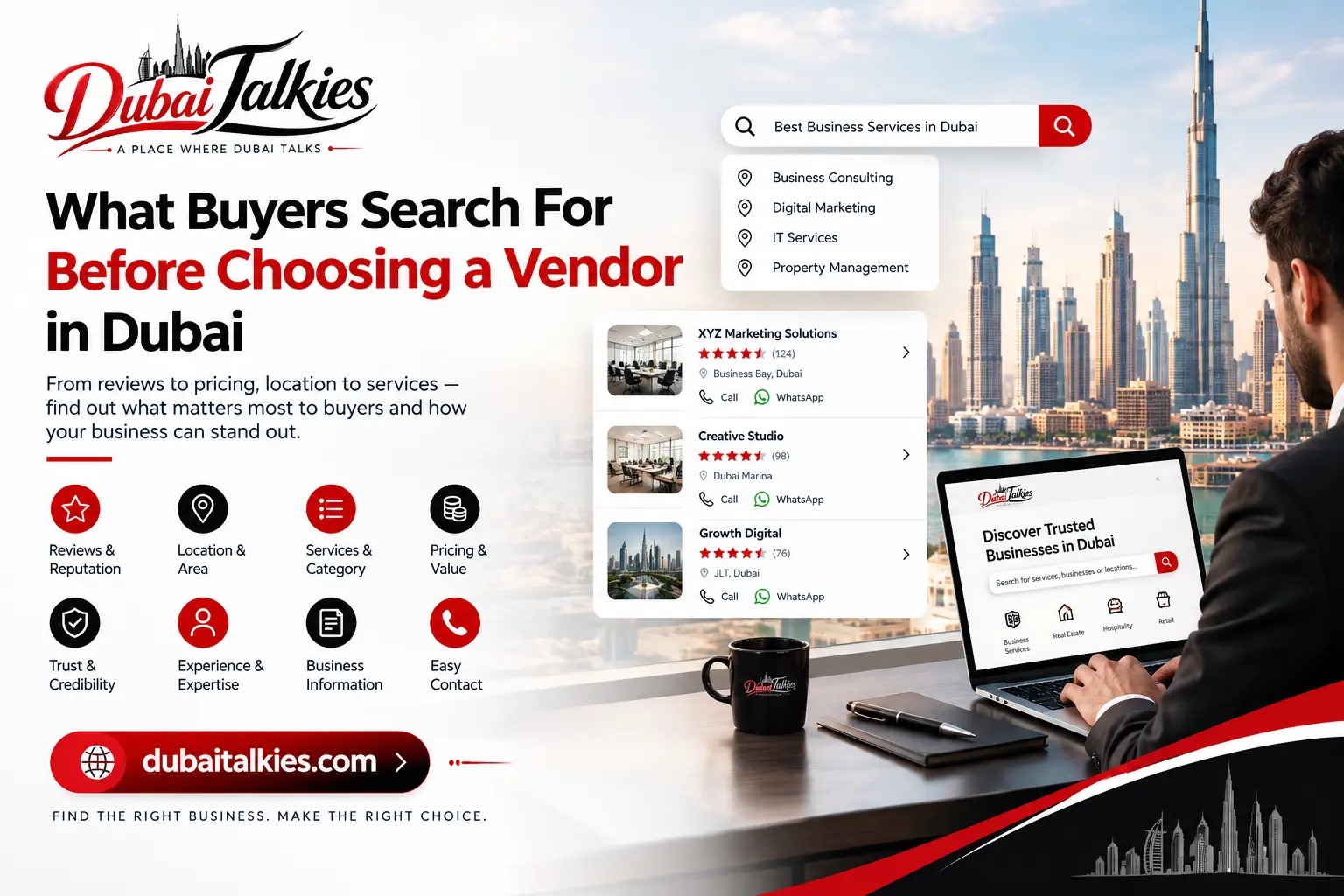
Choosing a vendor in Dubai is no longer a decision made only through personal recommendations, phone calls, or physical visits. Buyers increasingly begin their search online, compare several businesses, check available information, read reviews, and then decide which company deserves a call, WhatsApp message, meeting, or enquiry.
Whether the buyer is looking for a marketing agency, business consultant, contractor, supplier, property service provider, technology company, professional service firm, or another local business, the first stage of the buying journey is often discovery.
This creates an important opportunity for businesses operating in Dubai. Being present online is useful, but being easy to discover, compare, understand, and contact is much more important.
Research into the UAE digital market shows how significant online search has become. Google-related UAE research reports that 94% of adults in the country use Google Search at least once a month to compare product or service prices, while 80% use Google Maps or Waze monthly to find local businesses. Among those map users, 86% reported checking Google reviews at least monthly before visiting a local business.
This means that the modern vendor-selection process is heavily influenced by what a buyer can find online before making direct contact.
One of the biggest mistakes businesses make is assuming customers are already searching for their company name.
In many cases, they are not.
A buyer may search for “business automation company in Dubai,” “ERP company in Dubai,” “property management company Dubai,” “digital marketing agency Business Bay,” or “commercial property management services Dubai” without knowing which company they want.
This is where business discovery becomes important.
The buyer begins with a requirement and searches for businesses that can solve it. The companies that appear clearly in relevant search results have an opportunity to enter the buyer's consideration set.
This is also one of the reasons a well-structured business directory can be valuable. Instead of forcing buyers to move through dozens of unrelated pages, a directory can bring businesses together by category, service, location, and other useful information.
Current Dubai business directories increasingly organise businesses around categories, locations, contact information, reviews, photos, websites, and other decision-making information.
For businesses, this means that the question is no longer simply, “Do we have a website?”
The more important question is, “Can the right buyer discover us when they are actively looking for what we provide?”
The search process can vary depending on the industry, but several patterns appear repeatedly.
The first thing buyers generally want to establish is whether a company actually provides the service they need.
Someone looking for an ERP provider may search for “ERP companies in Dubai.” Someone looking for professional business support may search for “business consultants in Dubai.” A property owner may search for “property management companies in Dubai.”
The category tells the buyer whether the business is relevant.
For this reason, businesses should clearly communicate their primary services instead of relying on vague descriptions.
A listing that simply says “We are a leading company in Dubai” does not provide much value.
A stronger profile explains exactly what the company does, who it serves, where it operates, and what problems it solves.
Location remains an important part of local vendor discovery.
A buyer may not simply search for a service in Dubai. They may search for a service in Business Bay, JLT, Dubai Marina, Deira, Al Barsha, Downtown Dubai, or another area.
This is why location information should be accurate and clearly presented.
Modern directories are increasingly organised by both business category and neighbourhood because buyers often combine these two factors when searching for local providers.
For a vendor, an accurate location can therefore help answer an immediate buyer question:
“Can this company actually serve me?”
Once buyers identify a potential vendor, reputation becomes one of the most important evaluation factors.
Buyers want evidence that other customers have had a positive experience.
They may look at the overall rating, the number of reviews, recent reviews, customer comments, and how the business responds to feedback.
A five-star rating can attract attention, but buyers increasingly have more information available to them than just the rating number.
The volume and recency of reviews can also influence perception. Some UAE-focused research reports very high levels of review usage among consumers before purchasing decisions.
For businesses, this makes reputation management part of the broader visibility strategy.
A company can invest heavily in advertising, but if a prospective customer discovers poor reviews or very little information during the evaluation stage, that visibility may not convert into an inquiry.
Price is another major part of the vendor-selection journey.
Buyers may search for phrases such as “best,” “affordable,” “cost,” “pricing,” “packages,” or “quotes” alongside a service category.
However, buyers are not always searching for the cheapest provider.
They are often trying to understand whether the expected value is reasonable.
For example, a business owner comparing marketing agencies may want to understand the services included, expected deliverables, experience, reviews, and potential results before deciding whether a quoted price is justified.
This is why businesses should communicate value rather than simply displaying a price.
A buyer wants to know whether the vendor understands their specific requirement.
A company providing general technology services may not be the same choice as a company specialising in ERP implementation for SMEs.
Similarly, a general contractor may not be the preferred option for a buyer looking for a specialist commercial project.
Business profiles should therefore communicate relevant experience, industries served, capabilities, certifications where applicable, and areas of expertise.
The more clearly a company demonstrates relevance, the easier it becomes for a buyer to determine whether the business belongs on their shortlist.
Another important change in buyer behaviour is the expectation that basic information should already be available online.
Before contacting a vendor, a buyer may want to know the company's location, services, operating hours, website, phone number, WhatsApp availability, photographs, reviews, company description, and other relevant information.
Business directories increasingly provide these details directly within company profiles.
This reduces friction.
Imagine two companies offering the same service.
Company A has only a name and phone number.
Company B has a detailed profile explaining its services, location, photographs, website, reviews, contact options, and relevant business information.
Even before speaking to either company, the second business may appear more established and easier to evaluate.
That is the difference between simply being listed and being visible.
The role of online directories is also changing.
Traditional directories were often little more than lists of business names and telephone numbers. Modern platforms are becoming more useful discovery and comparison environments.
Current directory platforms increasingly combine business information with reviews, photographs, categories, locations, search filters, company descriptions, and direct contact options.
This reflects a broader Directory Trends 2026 pattern: buyers expect a business profile to answer important questions before they make contact.
The directory is becoming part of the buyer journey rather than simply a database.
For businesses, this creates a new opportunity. A strong profile can work as a digital introduction to the company and help move a buyer from discovery to consideration and finally to enquiry.
A business can technically have an online listing and still receive very little attention.
This happens when the listing is incomplete, poorly positioned, lacks useful information, has weak visual presentation, or does not communicate a clear reason for the buyer to choose the company.
Visibility involves more than existence.
It involves being discoverable for relevant searches, appearing in the right categories, presenting useful information, building trust, and making it easy for the buyer to take action.
This is particularly important for smaller and growing businesses competing against companies with larger marketing budgets.
A strong business profile gives smaller companies another opportunity to compete for attention based on relevance, information, reputation, and customer experience.
A business profile should be designed around the questions a potential customer is likely to ask.
It should clearly explain what the business does, which services it provides, where it operates, and who it serves.
The profile should also provide reliable contact information and make it easy for a potential customer to call, send an enquiry, visit the website, or start a conversation.
Visual information can also make a difference. Professional photographs, company branding, service images, project examples, or introductory videos can help buyers understand the business before contacting it.
Reviews and ratings can provide another layer of trust.
For businesses trying to improve their online presence, topics such as How Businesses Can Build Customer Trust Online become increasingly relevant because visibility without trust does not necessarily produce enquiries.
Similarly, businesses should consider How to Create a Standout Business Listing on DubaiTalkies when developing their profiles, because the quality of information presented can influence whether a buyer continues exploring or moves to another company.
Finding a business is only the first step.
The buyer then compares options.
They may open several company profiles, compare reviews, check services, visit websites, look at locations, assess credibility, and eventually contact a shortlist of vendors.
This is where lead generation becomes important.
A business platform should not only help companies get discovered. It should make the transition from discovery to enquiry as simple as possible.
Direct calls, WhatsApp conversations, enquiry forms, website visits, and other contact methods can turn visibility into measurable business opportunities.
That is why modern business discovery platforms are increasingly combining listings with lead-generation features, reviews, analytics, promotional placements, and other tools designed to support business growth.
Businesses in Dubai should think about their online presence from the buyer's perspective.
Instead of asking only, “Where can we list our company?” businesses should ask, “What information will a potential customer need before choosing us?”
The answer usually includes service relevance, location, reputation, experience, pricing or value, visual proof, contact information, and a clear reason to trust the company.
Businesses should also keep their information updated. An outdated phone number, incorrect address, missing service information, or old photographs can create unnecessary friction.
Consistency matters too. The company name, description, services, contact details, and other important information should be presented accurately across the platforms where the business appears.
This supports both customer confidence and long-term online visibility.
Dubai is a highly competitive business market. Companies across professional services, real estate, hospitality, technology, retail, construction, consulting, beauty, automotive, and many other sectors compete for the same customer attention.
The buyer often has several options available.
That makes the first impression increasingly important.
When a potential customer searches for a vendor, the businesses that provide useful information, strong credibility signals, clear services, and easy contact options have a better opportunity to move from search result to shortlist.
This is where platforms such as Dubaitalkies can support business discovery.
The goal is not simply to place another company name online. The objective is to help businesses build visibility, communicate their value, create trust, and generate opportunities from people actively searching for products and services in Dubai.
For a business owner, the key takeaway is simple: buyers do research before they buy, and your online business presence is part of that research.
A company that makes itself easy to find, understand, compare, and contact gives potential customers fewer reasons to move on to a competitor.
In 2026, being listed is only the starting point.
Being visible, credible, and discoverable is what can turn a listing into a business opportunity.
Buyers commonly search for services, locations, reviews, pricing, experience, business information, and contact details before choosing a vendor.
Reviews help buyers evaluate a vendor's reputation and understand other customers' experiences before making an enquiry or purchase.
Yes. Buyers often combine a service with a specific Dubai neighbourhood or area when looking for a convenient local vendor.
A complete listing gives buyers the information they need to understand, compare, trust, and contact a business before making a decision.
Businesses can improve visibility by maintaining accurate profiles, clearly presenting their services, building reviews, publishing useful information, and using platforms that help potential customers discover and contact them.



















Comments
No comments yet. Be the first to comment!