
3 Free Reels From Your Existing Video - Creator Trial (Free)
September 16, 2026










© Dubai Talkies. All rights reserved by zubaaly management LLC.
Digital transformation has become an important part of modern business growth. Companies of all sizes are using technology to improve the way they operate, communicate with customers, manage information and make business decisions.
However, digital transformation is not simply about buying new software or moving files from paper to computers. It is about changing how a business works by using technology more effectively.
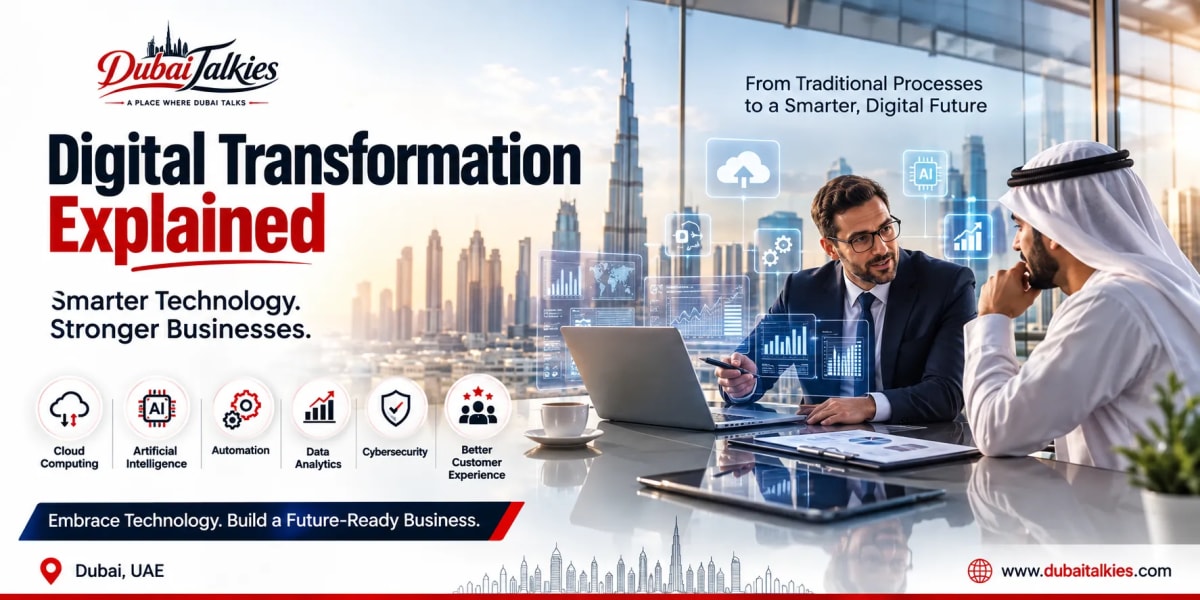
For a small business, this could mean introducing a customer relationship management system, automating repetitive tasks, accepting digital payments or improving its online presence. For a larger organisation, it could involve cloud infrastructure, artificial intelligence, data analytics, cybersecurity, automation and integrated business platforms.
For businesses operating in Dubai, digital transformation can also help companies respond to changing customer expectations and operate more efficiently in a competitive market.
This guide explains what digital transformation means, why it matters, what technologies are commonly involved, how businesses can approach it and what mistakes they should avoid.
Digital transformation is the process of using digital technologies to improve business operations, customer experiences, decision-making and overall business performance.
It involves more than introducing individual digital tools. A successful transformation usually requires businesses to reconsider existing processes and determine whether technology can make those processes faster, simpler, more accurate or more valuable.
For example, a company may previously have managed customer information using spreadsheets and email conversations. A digital transformation project could introduce a CRM system that stores customer information, tracks communication, manages leads and provides reports.
The technology itself is only one part of the transformation. Employees also need to understand how to use the system, processes may need to change and management needs to monitor whether the new approach is producing better results.
In simple terms, digital transformation means using technology to build a more efficient and adaptable business.
Customers increasingly expect businesses to provide convenient digital experiences. They may search for companies online, communicate through messaging platforms, make digital payments, compare services and expect quick responses.
Businesses that rely heavily on outdated processes may find it difficult to meet these expectations.
Digital transformation can help businesses improve operational efficiency, reduce repetitive work, organise information and provide faster customer service.
It can also help management make decisions using more reliable business data rather than depending entirely on assumptions or manual reports.
For example, a business with integrated sales and customer data can identify which services generate the most enquiries, which marketing channels produce customers and where potential customers are leaving the sales process.
The objective is not to adopt technology simply because it is new. The objective is to use technology to solve real business problems.
Digital transformation can affect almost every part of a business.
One of the most important areas is business operations. Companies can use software and automation to reduce manual processes, improve workflows and manage tasks more efficiently.
Another area is customer experience. Businesses can use websites, mobile applications, CRM systems, chat platforms and digital communication tools to make it easier for customers to interact with them.
Data management is also important. Businesses generate information through sales, marketing, customer interactions, finance and operations. Digital systems can help organise this information and make it easier to analyse.
Employee productivity can improve through collaboration tools, cloud applications, automation and digital workflows.
Finally, digital transformation can influence business strategy because better access to information can help management identify opportunities, understand customers and respond to market changes.
Cloud computing is one of the technologies that has significantly changed the way businesses use IT resources.
Instead of depending entirely on physical servers and locally installed systems, businesses can access computing resources, applications and storage through cloud platforms.
This can make it easier for employees to access business systems from different locations while also allowing companies to scale certain resources according to their requirements.
Cloud-based software can also simplify collaboration. Employees can work with shared documents, customer information and business applications without necessarily being in the same physical location.
For growing companies, cloud solutions can reduce the need to manage large amounts of physical IT infrastructure internally.
However, businesses still need to consider security, access controls, backups, data protection and vendor reliability when adopting cloud technology.
Artificial intelligence is becoming an increasingly important part of digital transformation.
Businesses can use AI for tasks such as customer support, content assistance, data analysis, document processing, forecasting and workflow automation.
For example, an AI-powered customer service system may help answer common questions, while employees can focus on more complex customer requests.
AI can also help businesses analyse large amounts of information and identify patterns that may be difficult to detect manually.
However, AI should not be treated as a solution to every business problem. Companies need to understand where AI can create measurable value and where human judgement remains essential.
Businesses should also consider data privacy, accuracy, security and responsible use when introducing AI into their operations.
Automation is another important component of digital transformation.
Many businesses spend significant amounts of time performing repetitive tasks such as sending emails, updating records, generating reports, transferring information between systems or following up with leads.
Automation can reduce the amount of manual work involved in these activities.
For example, when a customer submits an online enquiry, an automated workflow could record the lead, notify the appropriate employee and send an acknowledgement to the customer.
Automation does not necessarily mean replacing employees. In many cases, its purpose is to allow employees to spend more time on activities that require communication, creativity, decision-making and problem-solving.
The best automation opportunities are usually repetitive processes that are clearly defined and occur frequently.
Customer expectations have changed significantly as digital services have become part of everyday life.
Customers often expect businesses to provide fast responses, convenient communication, easy access to information and simple purchasing processes.
Digital transformation can help businesses respond to these expectations.
A company could improve customer experience through a faster website, online booking, digital payments, automated notifications, CRM software, customer portals or integrated communication channels.
Businesses can also use customer data to understand behaviour and provide more relevant experiences.
However, technology should not make customer interactions unnecessarily complicated. A sophisticated system is not useful if customers find it difficult to use.
The goal should be to remove friction rather than create additional digital steps.
Digital transformation is not only about customers. Employees can also benefit from better technology.
Employees may lose significant amounts of time searching for information, entering the same data into multiple systems or waiting for approvals.
Digital workflows can help reduce these inefficiencies.
Cloud collaboration platforms can make it easier for teams to work together, while project management systems can provide greater visibility into tasks and deadlines.
Internal knowledge systems can also help employees find important information more quickly.
When implemented correctly, technology can allow employees to focus more on productive and strategic work instead of repetitive administrative activities.
However, employee training is essential. Introducing a new system without teaching employees how to use it can create frustration and reduce productivity.
Data is one of the most valuable assets created by digital business operations.
Companies collect information about customers, sales, marketing campaigns, products, employees and financial performance.
Digital transformation can help businesses bring this information together and use it more effectively.
For example, a company could analyse customer acquisition data to determine which channels generate the highest-quality leads. Management could then allocate resources based on actual performance rather than assumptions.
Data can also help identify operational problems.
If a company notices that customers frequently abandon a particular stage of the buying process, it can investigate why that is happening and make improvements.
The quality of business decisions depends heavily on the quality of the underlying data. Businesses therefore need accurate, organised and properly managed information.
As businesses become more dependent on digital systems, cybersecurity becomes increasingly important.
A company that stores customer information, financial records and business data online needs appropriate protection against unauthorised access, data loss and other security threats.
Cybersecurity should therefore be considered from the beginning of a digital transformation project rather than added later.
Businesses should think about user permissions, strong authentication, secure software, employee awareness, backups and monitoring.
Employees also play an important role in cybersecurity. Human mistakes can create significant security risks, particularly when employees are not trained to recognise suspicious emails, links or requests for sensitive information.
Digital transformation should therefore improve security alongside efficiency.
These terms are often used interchangeably, but they describe different levels of change.
Digitisation generally means converting information from a physical format into a digital format. For example, scanning paper documents and storing them electronically.
Digitalisation involves using digital tools to improve an existing process. For example, replacing manual invoice processing with accounting software.
Digital transformation is broader. It involves changing business processes, operations, customer experiences or business models through the strategic use of technology.
The distinction is important because simply moving information into digital systems does not necessarily transform a business.
The benefits depend on the company's goals and how effectively the transformation is implemented.
Businesses may experience improvements in operational efficiency because digital systems can reduce manual work and simplify processes.
Customer service may improve when businesses can respond faster and provide customers with easier ways to communicate.
Better data can support more informed decision-making.
Automation can reduce repetitive tasks and allow employees to focus on higher-value activities.
Digital systems can also make businesses more adaptable because new processes and services can often be introduced more quickly than with heavily manual systems.
For some businesses, digital transformation can also create new revenue opportunities by enabling digital products, online services, subscription models or new customer channels.
Digital transformation can provide significant benefits, but it is not always easy.
One common challenge is resistance to change. Employees who are comfortable with existing processes may not immediately accept new systems.
Cost can also become a concern, particularly when businesses attempt to implement too many technologies at once.
Another challenge is poor planning. Companies sometimes purchase software before clearly defining the business problem they are trying to solve.
Integration can also be difficult when a business uses multiple systems that do not communicate effectively with one another.
Data security and privacy are additional considerations.
Businesses may also underestimate the importance of training. Even the best software will not produce the expected results if employees do not understand how to use it.
Small businesses do not need to transform everything at once.
A better approach is to identify areas where technology can create the greatest practical benefit.
Start by looking at repetitive tasks, customer communication, sales management, accounting, document management and internal workflows.
Ask where employees spend unnecessary time and where customers experience delays or inconvenience.
Once these problems are identified, the business can evaluate appropriate digital tools.
For example, a small company might begin by introducing a professional CRM system, cloud accounting software and automated customer follow-ups.
After employees become comfortable with these systems, the company can consider additional improvements.
A phased approach can make digital transformation easier to manage and reduce unnecessary spending.
A digital transformation strategy should begin with business objectives rather than technology.
The first question should be: What business problem are we trying to solve?
The next step is to understand the existing process and identify its weaknesses.
The company can then determine whether technology can address those weaknesses.
After selecting a solution, management should define responsibilities, timelines and measurable outcomes.
Employee training should be included from the beginning.
The business should also review results after implementation and make adjustments when necessary.
Digital transformation should be treated as an ongoing process rather than a one-time project.
Technology continues to evolve, customer expectations change and businesses grow. A system that works today may need to be improved in the future.
Not necessarily.
Replacing every system at the same time can be expensive, disruptive and difficult to manage.
In many cases, businesses can improve their existing technology environment gradually.
The first priority should be identifying systems that are outdated, inefficient, insecure or creating unnecessary manual work.
Some older systems may still perform an important function and may not need immediate replacement.
Businesses should evaluate technology based on business value rather than simply choosing the newest available solution.
A carefully planned combination of existing and new systems may be more practical than a complete technology replacement.
Employee training is one of the most important parts of digital transformation.
When employees understand why a new system is being introduced and how it will help them, they are more likely to adopt it successfully.
Training should focus not only on which buttons to click but also on how the new system changes existing workflows.
Businesses should provide employees with opportunities to ask questions and practise using new tools.
Management should also monitor adoption after implementation.
If employees continue using old manual processes alongside the new system, the expected benefits may not be achieved.
Successful transformation therefore requires both technological and organisational change.
Dubai has a highly competitive business environment where companies often compete for customers across digital channels.
A strong digital infrastructure can help businesses manage operations while also improving how they interact with customers.
For example, a Dubai-based company can use CRM software to manage enquiries, cloud systems to support teams, analytics to understand marketing performance and automation to improve follow-ups.
A strong online presence can also make it easier for potential customers to discover a company and understand its products or services.
Businesses should consider digital transformation alongside their broader growth strategy rather than treating technology as a separate activity.
For companies that want to improve their visibility online, being present on relevant digital business platforms can also support customer discovery.
One of the biggest mistakes is adopting technology without a clear objective.
Buying expensive software does not automatically improve a business.
Another common mistake is trying to implement too many systems at once. Employees can become overwhelmed, and management may struggle to measure which tools are actually producing results.
Ignoring cybersecurity is another serious mistake.
Businesses should also avoid choosing technology solely because competitors are using it. Every company has different requirements.
Poor employee communication can also create resistance.
Finally, businesses should not assume that digital transformation ends once a new system has been installed. Continuous monitoring and improvement are necessary to achieve long-term value.
Digital transformation should produce measurable business improvements.
The right measurements depend on the project.
For an automation project, the business might measure the amount of manual work reduced.
For a customer service project, it could monitor response times, customer satisfaction or resolution rates.
For a marketing transformation, the business could evaluate enquiries, conversions, customer acquisition costs and revenue generated.
For an operational project, management could examine productivity, processing times or error rates.
The important point is to establish a baseline before making major changes.
Without a starting point, it can be difficult to determine whether the transformation actually improved performance.
Digital transformation is likely to become increasingly connected with artificial intelligence, automation, cloud computing, data analytics and cybersecurity.
Businesses will continue looking for ways to reduce unnecessary manual work and improve customer experiences.
AI may become more integrated into everyday business applications, helping employees analyse information, create content, communicate with customers and complete routine tasks.
At the same time, businesses will need to pay greater attention to data security, privacy and responsible technology use.
The future is not simply about having more technology. It is about creating businesses that can use technology effectively while remaining flexible and customer-focused.
The best starting point is usually a business process review.
Identify where your company loses time, where customers experience difficulties and where employees perform repetitive tasks.
Then prioritise the problems that could have the greatest impact on business performance.
Choose technology based on those requirements rather than starting with a list of trendy tools.
Implement changes gradually, train employees and measure the results.
If the technology produces measurable improvements, continue expanding the approach.
If it does not, review the process and determine what needs to change.
Digital transformation works best when technology, people and business strategy move together.
Digital transformation is no longer simply a technology project. It is a business strategy focused on improving how a company operates, serves customers, manages information and prepares for future growth.
From cloud computing and automation to artificial intelligence, data analytics and digital customer experiences, technology can help businesses become more efficient and adaptable.
However, successful transformation does not depend on adopting the largest number of digital tools. It depends on choosing the right solutions for real business problems.
Businesses should begin with clear objectives, understand their existing processes, involve employees, protect their data and measure the results of every major initiative.
For businesses operating in Dubai, digital transformation can also support stronger customer engagement and online visibility. As more customers use digital channels to research companies, products and services, having an effective digital presence can become an important part of business growth.
This is where Dubaitalkies can also play a role. Dubaitalkies is a Dubai-focused digital business discovery platform designed to help businesses showcase their companies, products and services and make it easier for potential customers to discover businesses operating in Dubai.
Technology can improve the way a business operates internally, while a strong digital presence can help that business become more visible externally.
The goal of digital transformation is therefore not simply to become more digital. It is to build a smarter, more efficient and more adaptable business that is better prepared for changing customer expectations and future opportunities.
Digital transformation means using technology to improve how a business operates, serves customers, manages information and makes decisions. It involves changes to both technology and business processes.
Digital transformation can help businesses improve efficiency, reduce repetitive work, provide better customer experiences, use data more effectively and adapt to changing market conditions.
Common technologies include cloud computing, artificial intelligence, automation, CRM software, data analytics, cybersecurity solutions, collaboration platforms and digital payment systems.
No. Small and medium-sized businesses can also benefit from digital transformation. A small business can begin with simple improvements such as cloud software, CRM systems, automation or better digital customer communication.
There is no fixed timeline. Small improvements may be implemented relatively quickly, while larger transformation projects involving multiple systems, departments and processes can take considerably longer.
One of the biggest mistakes is adopting technology without first identifying the business problem it is supposed to solve. Technology should support clear business objectives rather than being introduced simply because it is popular.
Businesses can use digital systems to provide faster communication, easier payments, online services, personalised experiences, automated updates and more convenient ways for customers to interact with the company.
Yes. Employees need to understand how new systems work and how their daily processes will change. Proper training can improve adoption and help businesses achieve greater value from their technology investments.













Comments
No comments yet. Be the first to comment!