
3 Free Reels From Your Existing Video - Creator Trial (Free)
September 16, 2026










© Dubai Talkies. All rights reserved by zubaaly management LLC.
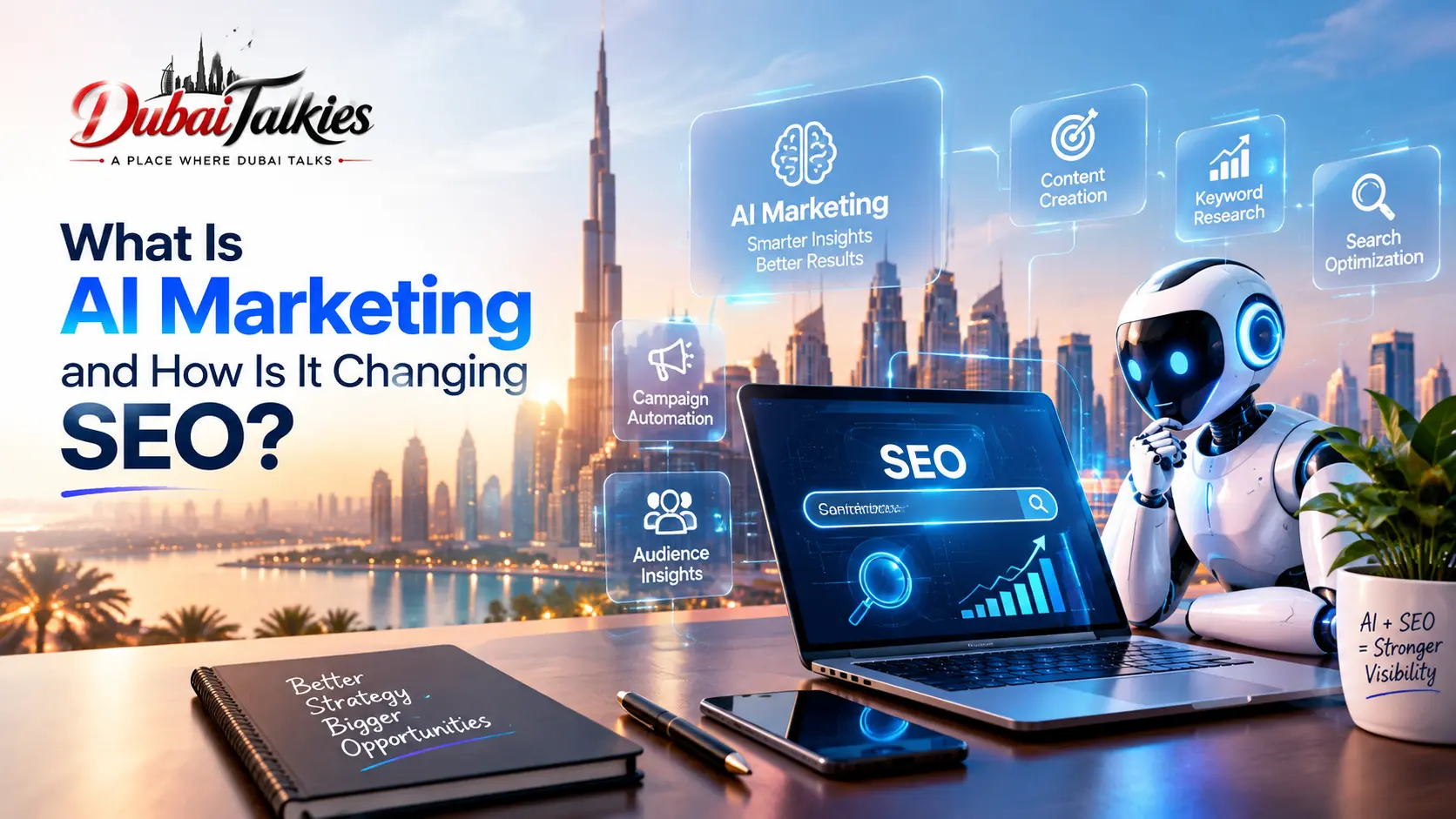
Artificial intelligence is changing how businesses understand customers, create marketing campaigns, analyze performance, and manage their digital presence. What was once limited to advanced data analysis is now becoming part of everyday marketing workflows, from generating content ideas and identifying customer segments to analyzing search intent and improving website content. This shift has also changed the relationship between marketing and SEO because search engines are increasingly using AI to understand queries, content, context, and user needs.
For businesses, AI marketing does not mean simply replacing traditional marketing with automated software. It means using artificial intelligence to process information, identify patterns, support decisions, personalize experiences, and automate repetitive tasks while keeping human strategy at the center. SEO is evolving in a similar way. Google says its generative AI search experiences continue to rely on foundational SEO practices, while emphasizing unique, valuable, people-first content rather than special “AI-only” optimization techniques.
Understanding this relationship is becoming increasingly important for businesses that want to remain visible as search behavior and digital marketing continue to evolve.
AI marketing is the use of artificial intelligence technologies to support marketing activities such as customer analysis, content planning, personalization, campaign optimization, forecasting, automation, and performance measurement. Instead of relying only on manually collected information and predefined marketing processes, businesses can use AI systems to process large amounts of data and identify patterns that may be difficult to detect manually. This allows marketing teams to make more informed decisions while spending less time on repetitive analytical and administrative work.
Traditional marketing can involve extensive manual research, segmentation, reporting, content planning, and campaign monitoring. AI marketing adds another layer by helping businesses interpret information and respond to changing customer behavior more efficiently. For example, an AI system can help identify common questions customers ask, group audiences according to behavior, analyze campaign performance, or suggest content topics based on existing information. The technology does not remove the need for strategy because businesses still need to determine their goals, audience, positioning, messaging, and brand standards. AI is most useful when it supports those decisions rather than attempting to make every marketing decision independently.
AI marketing works by combining data, algorithms, machine learning models, and automation to identify patterns and generate useful outputs. Depending on the system being used, AI can process information from websites, customer interactions, advertising campaigns, search behavior, CRM systems, social media activity, and other business sources. The resulting analysis can help marketers understand what audiences are interested in, which content receives attention, where customers drop out of a process, and which marketing activities may require further investigation.
A practical AI marketing strategy therefore usually involves a combination of technology and human decision-making. AI may identify an emerging customer trend, but a marketer still needs to determine whether that trend is relevant to the business. AI can generate several content ideas, but an editor should decide which ideas are accurate, useful, original, and appropriate for the brand. This combination is important because marketing involves context, positioning, creativity, trust, and business objectives that cannot always be reduced to patterns in historical data. Businesses can explore this wider operational role of artificial intelligence through how AI is changing business operations, particularly when considering how automation can extend beyond marketing.
AI is changing SEO by making search engines better at understanding the meaning behind queries and by giving marketers more sophisticated ways to analyze content, topics, entities, and user intent. Search is no longer limited to matching a few words on a webpage with the words entered into a search box. Modern search systems can interpret relationships between concepts and retrieve information from multiple sources. Google's current guidance says its generative AI search experiences are built on its core Search systems and can use techniques such as retrieval-augmented generation and query fan-out to find relevant information.
This means SEO increasingly requires businesses to think beyond individual keywords. A page targeting “digital marketing agency Dubai,” for example, may need to address the services, customer problems, industry context, location, expertise, pricing considerations, and questions surrounding that topic. AI can help marketers identify these relationships, but the objective remains creating useful content for people. Google's guidance specifically emphasizes valuable, unique, non-commodity content and says that existing SEO fundamentals remain relevant for generative AI search.
AI can make keyword research more contextual by helping marketers examine related queries, questions, concepts, entities, and potential search intents. Instead of looking only at search-volume figures, marketers can use AI-assisted analysis to understand whether a person is researching a topic, comparing providers, looking for a solution, preparing to make a purchase, or seeking a specific local service. This can help create content that addresses the underlying reason behind a search rather than simply repeating a target phrase.
Search intent analysis is particularly important because people can use completely different wording to look for similar information. Someone searching for “AI marketing tools,” for example, may want a comparison, while another person searching “how AI helps marketing” may want an explanation. AI can help identify these relationships and organize them into useful content opportunities. However, keyword research should still be validated using actual search results, business knowledge, customer questions, and reliable SEO data. AI-generated keyword suggestions should be treated as research assistance rather than automatically correct search-demand information.
AI has changed content creation by helping marketers research subjects, develop outlines, identify questions, create drafts, improve readability, and discover potential content gaps. These capabilities can reduce the time required for repetitive parts of the editorial process and allow marketers to spend more time on research, expertise, examples, editing, and strategic decisions. AI can also help transform existing business information into different formats, such as turning research notes into an article structure or converting a long explanation into shorter educational content.
However, effective AI content creation requires more than generating a large number of articles. Google states that using AI is not automatically against its Search guidelines, but generating many pages primarily to manipulate search rankings and without adding value can fall under its scaled content abuse policy. Businesses should therefore add information that demonstrates genuine expertise, first-hand experience, original analysis, accurate examples, and useful context. The goal should be to use AI as part of a strong editorial process rather than treating it as a replacement for research and human judgment.
AI can support many aspects of on-page SEO by analyzing the relationship between a page's topic, headings, title, metadata, internal links, entities, and user questions. It can help marketers identify missing subtopics, suggest alternative title structures, review whether a page addresses common questions, and identify opportunities for better internal linking. AI can also assist with content briefs by organizing research into a logical structure before an article is written.
These capabilities are useful because on-page SEO involves many connected elements rather than one isolated keyword. A page should have a clear purpose, useful headings, relevant information, descriptive metadata, logical internal links, and content that satisfies the visitor's intent. AI can identify potential improvements, but the recommendations still need to be reviewed against the actual page and audience. Google's guidance for generative AI search continues to emphasize fundamental SEO practices, including crawlability, clear technical structure, useful content, and good page experience.
AI can assist technical SEO by processing large amounts of website information and identifying patterns that deserve attention. For example, AI-supported systems can help organize crawl data, detect repeated metadata problems, identify internal-linking gaps, analyze large groups of URLs, find potential duplicate-content patterns, and highlight pages that may require further technical investigation. This can be especially useful for large websites where manually reviewing every page would require substantial time.
AI should not, however, be treated as a substitute for technical validation. A system may identify a possible issue without understanding the full technical context or business importance of that issue. Developers and SEO professionals still need to inspect the website, test changes, validate structured data, review indexing behavior, and monitor the impact of implementation. Google also notes that crawlability, technical requirements, JavaScript SEO, page experience, and duplicate-content management remain relevant to visibility in generative AI search.
AI is also changing how local businesses can approach search visibility because users increasingly ask detailed questions about services, businesses, locations, availability, and specific requirements. Instead of searching only for a short phrase such as “SEO agency Dubai,” a user may ask which SEO agency serves a particular industry, location, budget, or business type. This creates opportunities for businesses to publish content that answers specific questions while maintaining accurate business information across their digital presence.
For local businesses, this makes consistency especially important. Business names, services, locations, contact information, descriptions, reviews, and other important details should be accurate and regularly maintained. Business websites, search profiles, social platforms, directories, and business discovery platforms can all contribute to the information customers encounter. A Dubai-focused platform such as Dubaitalkies can provide another business-discovery touchpoint, but businesses should treat it as part of a broader digital presence rather than a replacement for their website or other search channels.
AI can automate or accelerate many tasks performed by SEO professionals and marketers, but that does not mean every strategic marketing responsibility can simply be handed to an AI system. Keyword clustering, content research, reporting, data organization, first-draft creation, and repetitive analysis are examples of areas where AI can provide meaningful assistance. Human professionals can then spend more time interpreting information, understanding customers, developing positioning, checking accuracy, and deciding what actions make sense for the business.
SEO also involves judgment because search performance is influenced by many factors that require contextual interpretation. A marketer may need to determine whether a topic genuinely matches the company's expertise, whether a piece of content provides something different from competing pages, whether a technical change could create another problem, or whether a particular keyword is commercially relevant. AI can support these decisions, but it does not remove the need for experience and accountability. The broader relationship between AI, technology, and business modernization is also discussed in Digital Transformation Explained.
One of the biggest risks of using AI for SEO is producing content that looks complete but provides little original value. AI can generate fluent paragraphs very quickly, but fluent writing does not automatically mean accurate, authoritative, or useful information. Content can also contain factual errors, outdated information, generic explanations, repetitive language, incorrect assumptions, or examples that do not reflect the business's actual experience. Publishing such material without review can weaken the usefulness of a website even when the pages are technically optimized.
Another risk is excessive automation. Creating large quantities of similar pages simply because AI makes production inexpensive can result in duplication, thin information, and poor user experiences. Google's current guidance specifically warns against generating large amounts of unoriginal content primarily for search manipulation and recommends focusing on accuracy, quality, relevance, and people-first value. Businesses should therefore establish an editorial process in which AI-assisted material is researched, fact-checked, edited, and improved with genuine business expertise before publication.
Businesses can use AI marketing most effectively when they begin with a clear business objective rather than starting with the technology itself. If the goal is to improve organic visibility, AI might help analyze existing content, identify unanswered customer questions, organize keyword research, and develop content briefs. If the goal is customer retention, AI may help identify behavioral patterns or personalize communications. If the goal is operational efficiency, automation may reduce repetitive reporting and administrative tasks.
The strongest approach is usually a combination of AI efficiency and human expertise. Businesses can use AI to process information and accelerate repetitive work while allowing experienced people to control strategy, brand voice, accuracy, customer understanding, and final decisions. This also makes it easier to maintain consistency across websites, business profiles, social media, and other digital channels. The broader development of AI across Dubai's business environment is explored in Dubai's AI revolution and its impact on businesses, which provides additional context for businesses considering how artificial intelligence is becoming part of everyday operations.
The future of SEO is likely to involve more complex search experiences in which users ask detailed questions and receive synthesized answers alongside links to supporting sources. Google has introduced AI search experiences that can combine information from multiple searches and sources, while its 2026 guidance emphasizes that traditional SEO fundamentals remain important for visibility in generative AI experiences. This means businesses should focus less on trying to discover a single “AI ranking trick” and more on building websites that search systems and users can understand.
Search is also becoming increasingly multimodal. Google announced in September 2026 that Search Console was expanding reporting for web multimodal search, including searches involving Google Lens, Circle to Search, image uploads, and other image-based search interactions. For businesses, this suggests that SEO can increasingly involve useful text, relevant images, video, structured information, and clear business data. The underlying principle remains straightforward: create valuable information, maintain a technically accessible website, demonstrate genuine expertise, and make it easy for people to understand what the business offers.
AI marketing is reshaping how businesses understand customers, develop campaigns, create content, analyze performance, and manage their digital presence. Its influence on SEO is also becoming more significant as search systems increasingly use artificial intelligence to understand queries, connect related concepts, interpret user intent, and deliver more contextual answers. For marketers, this creates new opportunities to improve keyword research, discover content gaps, understand customer questions, strengthen on-page optimization, and automate repetitive SEO activities while keeping strategic decisions under human control.
For businesses in Dubai, this changing digital environment makes online visibility increasingly important. Platforms such as Dubaitalkies can complement a company’s website, search presence, social media channels, and other digital touchpoints by giving businesses another place to present their services, expertise, business information, reviews, and contact details. A strong digital presence is not created by AI alone; it comes from combining useful information, genuine business expertise, accurate content, technical SEO, consistent brand information, and a clear understanding of what customers are searching for. AI can support that process, but human judgment and originality remain essential.
As AI continues to influence marketing and search, businesses should focus on using it as a practical tool rather than treating it as a shortcut to rankings or visibility. For Dubai businesses, combining AI-assisted marketing with quality content, search optimization, business discovery, and platforms such as Dubaitalkies can help create a broader and more consistent digital presence. The businesses that continually understand their customers, adapt to changing search behavior, and maintain useful and trustworthy information will be better positioned to respond to the evolving digital landscape.
AI marketing is the use of artificial intelligence to support marketing activities such as customer analysis, personalization, content planning, campaign optimization, automation, forecasting, and performance analysis. It helps marketers process information and automate repetitive work while human professionals continue to control strategy and important business decisions.
AI is changing SEO by improving how search systems understand language, context, relationships between topics, and user intent. It is also helping SEO professionals analyze keywords, content gaps, technical issues, internal links, and large amounts of website data more efficiently.
AI can automate and accelerate many SEO tasks, but it does not remove the need for SEO professionals. Strategy, business understanding, content expertise, technical judgment, quality control, and interpretation of search data still require human involvement.
AI-generated content is not automatically bad for SEO. The important consideration is whether the content is useful, accurate, original, relevant, and created for people rather than primarily to manipulate search rankings. Google specifically warns against scaled AI content that provides little or no value to users.
AI can help identify related queries, questions, topics, entities, and possible search intents from a broader subject. However, AI-generated suggestions should be checked against real search results, reliable SEO data, customer needs, and the business's actual expertise before being used in an SEO strategy.
SEO is likely to become increasingly connected with AI-powered and multimodal search experiences. However, current Google guidance indicates that foundational SEO practices, crawlability, technical accessibility, and unique, useful content remain important for visibility in generative AI search.
Businesses can use AI for SEO research, content planning, analysis, automation, and repetitive tasks, provided the output is properly reviewed. The strongest approach combines AI-assisted efficiency with human expertise, original information, factual accuracy, strategic decision-making, and a focus on satisfying the user's actual needs.










Comments
No comments yet. Be the first to comment!