
3 Free Reels From Your Existing Video - Creator Trial (Free)
September 16, 2026










© Dubai Talkies. All rights reserved by zubaaly management LLC.
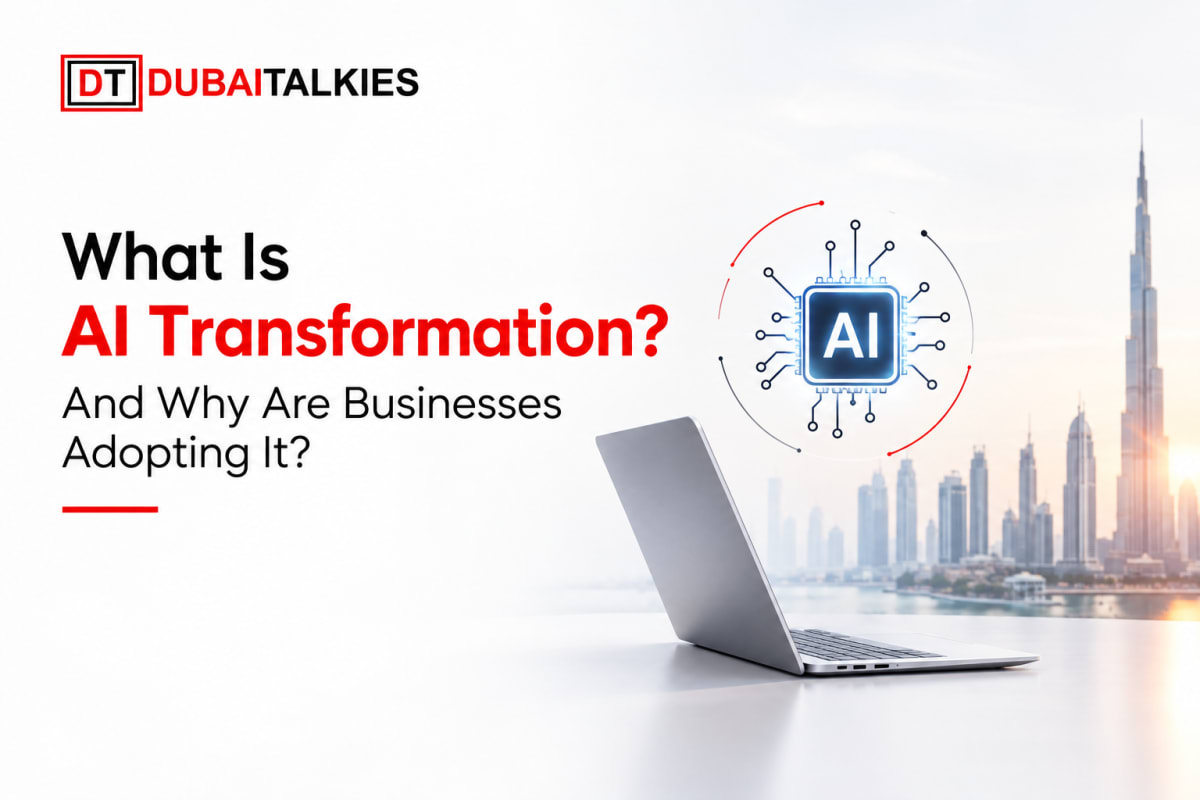
AI transformation is the process of using artificial intelligence across different parts of a business to improve how work is performed, decisions are made, customers are served, and growth is achieved.
Unlike simply adding an AI chatbot or using an AI writing tool, AI transformation involves a broader change in how an organization operates. It can affect marketing, sales, customer service, finance, operations, human resources, analytics, product development, and decision-making.
Businesses are increasingly moving from traditional digital transformation toward AI-enabled transformation because AI can analyze large amounts of information, identify patterns, automate repetitive work, generate content, predict customer behavior, and support faster decision-making.
For example, a company may use AI to analyze customer data, automatically personalize email marketing campaigns, identify high-value leads, optimize advertising campaigns, generate SEO content ideas, forecast demand, and provide automated customer support.
The objective is not simply to use more AI. The objective is to use AI where it can create measurable business value.
Businesses are adopting AI transformation because traditional processes often require significant amounts of manual work, data analysis, and repetitive decision-making.
AI can help organizations process information faster and create more scalable workflows.
According to the type of business, AI transformation can contribute to several areas of growth.
Business Area | Traditional Approach | AI-Enabled Approach |
Marketing | Manual campaign planning | AI-assisted campaign optimization |
SEO | Manual keyword research | AI-assisted search and topic analysis |
Customer Service | Human-only support | AI-assisted 24/7 support |
Sales | Manual lead qualification | AI-based lead scoring |
Email Marketing | Same message for large audiences | Personalized campaigns |
Advertising | Manual optimization | Automated performance optimization |
Analytics | Periodic reporting | Faster predictive insights |
Operations | Rule-based workflows | Intelligent automation |
The biggest attraction is the ability to combine automation, data, personalization, and decision support within one business ecosystem.
Digital transformation and AI transformation are related, but they are not exactly the same.
Digital transformation focuses on using digital technologies to improve business processes. AI transformation takes this further by introducing artificial intelligence into those digital systems.
A company moving from paper-based records to cloud software is undergoing digital transformation. A company using AI to analyze those records, predict customer demand, automate workflows, and recommend business decisions is moving toward AI transformation.
Digital Transformation | AI Transformation |
Digitizes business processes | Makes processes intelligent |
Uses cloud and software | Uses AI and machine learning |
Automates predefined tasks | Can support adaptive decisions |
Focuses on digital infrastructure | Focuses on intelligence + automation |
Improves accessibility | Improves prediction and personalization |
Data is collected digitally | Data can be analyzed intelligently |
This is why AI transformation can be viewed as an evolution of digital transformation rather than a completely separate concept.
AI transformation normally involves several connected components rather than one technology.
Businesses can use AI to automate repetitive processes such as data entry, document processing, customer queries, reporting, scheduling, and workflow management.
Automation can allow employees to spend more time on activities requiring creativity, strategy, communication, and human judgment.
Modern businesses generate information through websites, applications, social media, CRM systems, advertising platforms, sales systems, and customer interactions.
AI can help organizations identify patterns in this information and convert raw data into useful insights.
For example, an organization may identify which customer segments are most likely to purchase a particular service.
AI can analyze historical information to identify potential future outcomes.
Businesses can apply predictive models to areas such as sales forecasting, customer retention, inventory planning, demand forecasting, and lead scoring.
AI can help businesses provide different experiences to different customers.
Instead of sending the same marketing message to everyone, businesses can use customer behavior and preferences to create more relevant content, offers, recommendations, and communication.
Generative AI can create text, images, summaries, ideas, code, marketing concepts, and other forms of content.
However, businesses still need human oversight to ensure that generated content is accurate, useful, original, and aligned with the brand.
AI is transforming digital marketing by helping marketers understand audiences, create content, analyze campaigns, and optimize customer journeys.
A modern digital marketing agency may use AI-assisted systems for research, content planning, audience analysis, campaign optimization, reporting, and personalization.
The role of marketers is therefore shifting from performing every individual task manually toward managing technology, strategy, creativity, data, and customer experience.
Marketing Activity | Possible AI Application |
Market research | Pattern and trend analysis |
Content creation | Draft generation |
Audience research | Customer segmentation |
Campaign optimization | Performance analysis |
Email marketing | Personalization |
Advertising | Bid and audience optimization |
Social media | Content analysis and ideation |
Reporting | Automated summaries |
Customer service | AI-assisted responses |
The important point is that AI does not automatically replace digital marketing strategy. Instead, it can increase the speed and scale at which marketers execute that strategy.
An AI marketing agency combines traditional marketing expertise with AI-powered technologies and workflows.
Instead of relying entirely on manual processes, an AI marketing agency can use artificial intelligence to improve research, content planning, campaign analysis, customer segmentation, automation, and performance optimization.
For businesses, the value can come from combining three elements:
Human strategy + AI capabilities + business data
This combination is particularly useful when companies have large amounts of customer or campaign information but do not have the internal resources to analyze everything manually.
An AI marketing agency may support areas such as SEO, paid advertising, social media marketing, email marketing, conversion optimization, analytics, and marketing automation.
AI is also changing the way businesses approach search engine optimization.
Traditional SEO has focused heavily on keyword research, technical optimization, backlinks, content creation, and rankings.
These fundamentals remain important, but search has become more focused on intent, context, entities, relevance, helpful content, and user experience.
AI SEO can assist marketers with tasks such as:
Search intent analysis
Topic research
Content gap analysis
Keyword clustering
Competitor analysis
Content briefs
Internal linking analysis
SERP pattern analysis
Content optimization
Performance monitoring
However, AI-generated content alone does not guarantee rankings.
A website still needs useful information, strong topical relevance, technical accessibility, credibility, original insights, and a good user experience.
AI SEO refers to the use of artificial intelligence to support search engine optimization activities.
The goal is not to create thousands of automatically generated pages simply because AI makes content production faster.
Instead, AI SEO can help SEO professionals understand search behavior and make better decisions.
For example:
Traditional workflow:
Keyword research → manual grouping → content planning → writing → optimization → reporting
AI-assisted workflow:
Search data → AI-assisted clustering → intent analysis → content planning → human-led creation → optimization → automated insights
The second workflow can potentially reduce repetitive work while allowing SEO professionals to spend more time on strategy and quality.
Social media marketing generates large amounts of information every day.
AI can help businesses analyze engagement patterns, identify content themes, understand audiences, generate content ideas, and assist with campaign optimization.
A social media marketing agency can use AI-assisted tools to analyze which topics, formats, audiences, and messages are generating stronger responses.
For example, a business could analyze thousands of social interactions to identify recurring customer questions.
Those questions could then become:
Social post → Blog article → Email → Video → FAQ → Sales content
This creates an interconnected content ecosystem rather than treating every marketing channel separately.
Email marketing is another area where AI transformation can have a significant impact.
Traditional email campaigns often rely on broad audience segments.
AI can help businesses move toward more personalized communication by analyzing customer behavior and interactions.
Email Activity | AI Opportunity |
Subject lines | Generate and test variations |
Segmentation | Identify behavioral groups |
Timing | Identify potentially effective send times |
Recommendations | Suggest relevant products/services |
Personalization | Adapt messages to customer behavior |
Reporting | Identify campaign patterns |
Retention | Detect engagement changes |
For example, instead of sending one promotional email to 10,000 subscribers, a business could develop different communication strategies based on customer behavior and engagement.
Paid advertising requires continuous analysis and optimization.
Businesses running Google Ads, social advertising, display advertising, or other campaigns need to evaluate factors such as audiences, creative performance, conversions, costs, and return on investment.
AI can assist with analyzing these signals and identifying optimization opportunities.
Advertising Challenge | AI-Assisted Opportunity |
Audience selection | Identify behavioral patterns |
Creative testing | Generate variations |
Campaign analysis | Detect performance trends |
Budget allocation | Support optimization |
Lead quality | Identify patterns |
Conversion prediction | Estimate likely outcomes |
However, advertising decisions should still be connected to actual business objectives.
More clicks do not necessarily mean more customers.
The important measurement is whether advertising produces qualified leads, sales, revenue, or another meaningful business outcome.
Performance marketing is heavily dependent on measurable outcomes.
This makes it particularly suitable for AI-assisted optimization because campaigns generate continuous streams of data.
AI can help analyze:
Impressions → Clicks → Engagement → Leads → Conversions → Revenue
Instead of focusing only on surface-level metrics, businesses can build systems that evaluate the entire customer journey.
For example, a campaign with a low cost per click may initially appear successful. But if those clicks generate poor-quality leads, the campaign may not actually perform well.
AI-assisted analysis can help marketers identify relationships between campaign activity and downstream business results.
Businesses can experience several potential benefits when AI is implemented strategically.
AI can automate repetitive activities and help employees complete certain tasks faster.
AI can process large amounts of information quickly, giving teams more opportunities to identify trends and patterns.
Businesses can use customer data to create more relevant experiences.
AI-powered workflows can help businesses handle increasing volumes of information and customer interactions.
AI can support faster responses, personalized recommendations, and always-available assistance.
AI can reduce repetitive marketing work and help teams analyze campaign performance more efficiently.
AI can turn large amounts of raw data into actionable insights.
AI transformation is not automatically successful simply because an organization adopts AI tools.
Businesses can face several challenges.
Challenge | Why It Matters |
Poor data quality | AI depends on reliable information |
Lack of strategy | Tools without objectives create limited value |
Employee resistance | New workflows require adoption |
Privacy concerns | Customer data must be handled responsibly |
Incorrect AI output | Human review may be necessary |
Integration problems | AI must work with existing systems |
High implementation complexity | Large-scale transformation requires planning |
One of the most common mistakes is treating AI transformation as a technology project instead of a business transformation project.
The question should not be “Where can we use AI?”
A better question is:
“Which business problem can AI solve better, faster, or more efficiently?”
Businesses do not necessarily need to transform every department at once.
A practical approach is to start with one high-value business problem.
Step | Action |
1 | Identify a business problem |
2 | Evaluate available data |
3 | Select an appropriate AI solution |
4 | Run a small pilot |
5 | Measure business results |
6 | Improve the workflow |
7 | Scale across departments |
For example, a company could begin with customer-service automation.
Once the workflow demonstrates measurable value, the company could expand AI into marketing analytics, lead qualification, email marketing, SEO, sales forecasting, and other areas.
This approach reduces unnecessary investment while allowing the organization to learn from real-world implementation.
AI transformation is not limited to technology companies.
It can be applied across many industries.
Industry | Example AI Applications |
E-commerce | Recommendations and demand forecasting |
Real Estate | Lead scoring and property recommendations |
Healthcare | Administrative automation and analysis |
Finance | Risk analysis and fraud detection |
Manufacturing | Predictive maintenance |
Education | Personalized learning |
Retail | Customer personalization |
Marketing | Campaign optimization |
Logistics | Route and demand optimization |
Professional Services | Document and workflow automation |
The opportunity depends on the availability of useful data, business processes, technology infrastructure, and a clearly defined objective.
AI transformation is likely to become increasingly connected with everyday business operations.
Rather than having AI exist as a separate tool, businesses may increasingly integrate AI into CRM platforms, marketing systems, customer service, analytics, sales operations, websites, internal workflows, and enterprise software.
The future is therefore less about asking whether a company uses AI and more about how effectively AI is integrated into the organization's operating model.
Businesses that successfully combine AI with human expertise may gain advantages in speed, personalization, operational efficiency, and decision-making.
At the same time, human judgment will remain important because business decisions involve context, ethics, creativity, relationships, and accountability.
Factor | Traditional Transformation | AI Transformation |
Main focus | Digitization | Intelligence + digitization |
Automation | Rule-based | AI-assisted/adaptive |
Data use | Reporting | Prediction and insights |
Customer experience | Digital channels | Personalized experiences |
Marketing | Digital campaigns | AI-assisted optimization |
Decision-making | Human analysis | Human + AI analysis |
Scalability | Technology-driven | Technology + intelligence-driven |
The distinction is important because simply moving a process online does not necessarily make it intelligent.
AI transformation aims to make business systems more capable of learning from information, identifying patterns, generating insights, and supporting decisions.
The next stage of AI adoption is likely to involve deeper integration rather than isolated experimentation.
Here are 10 areas businesses should monitor:
AI-powered customer service
AI-assisted SEO
Generative AI for marketing
Predictive analytics
AI-powered personalization
Automated campaign optimization
AI sales assistants
Intelligent business automation
AI-powered data analysis
AI agents connected to business workflows
These developments could change how companies approach digital marketing, SEO, advertising, sales, customer support, and operational management.
1. What does AI transformation mean?
AI transformation means integrating artificial intelligence into business processes, decision-making, customer experiences, marketing, operations, and other areas to improve efficiency and business outcomes.
2. Why is AI transformation important for businesses?
AI transformation can help businesses automate repetitive work, analyze data faster, personalize customer experiences, improve decision-making, and scale certain processes.
3. Is AI transformation the same as digital transformation?
No. Digital transformation focuses on adopting digital technologies, while AI transformation introduces artificial intelligence to make processes more intelligent, automated, predictive, and personalized.
4. What is an AI marketing agency?
An AI marketing agency combines marketing expertise with artificial intelligence and automation to support activities such as SEO, advertising, content, analytics, personalization, and campaign optimization.
5. What is AI SEO?
AI SEO is the use of artificial intelligence to support SEO activities such as search-intent analysis, keyword clustering, content planning, optimization, competitor research, and performance analysis.
6. Can small businesses use AI transformation?
Yes. Small businesses can begin with focused applications such as customer support, email marketing, lead qualification, content workflows, analytics, advertising optimization, or business automation instead of implementing AI across the entire organization.
7. Will AI replace digital marketing agencies?
AI is more likely to change how digital marketing agencies work than simply eliminate the need for them. Strategy, creativity, brand understanding, business context, and human judgment remain important.
8. How should a company start AI transformation?
A company should start by identifying a specific business problem, evaluating its data and existing technology, testing a focused AI solution, measuring results, and scaling successful workflows.
AI transformation is becoming an important part of modern business strategy because artificial intelligence can influence far more than content creation.
It can affect marketing, SEO, advertising, customer service, sales, analytics, automation, personalization, and operational decision-making.
The businesses most likely to benefit are not necessarily those using the largest number of AI tools. They are the organizations that identify meaningful problems and integrate AI into workflows where it can create measurable value.
For marketers, this means understanding how AI is changing SEO, digital marketing, social media, email marketing, advertising, and performance marketing.
For business leaders, it means looking beyond individual AI tools and considering how artificial intelligence can become part of the company's broader digital transformation strategy.
The future of AI transformation is therefore not simply human versus AI.
It is increasingly about human expertise working with AI to build faster, smarter, and more scalable businesses.









Comments
No comments yet. Be the first to comment!