
3 Free Reels From Your Existing Video - Creator Trial (Free)
September 16, 2026











© Dubai Talkies. All rights reserved by zubaaly management LLC.
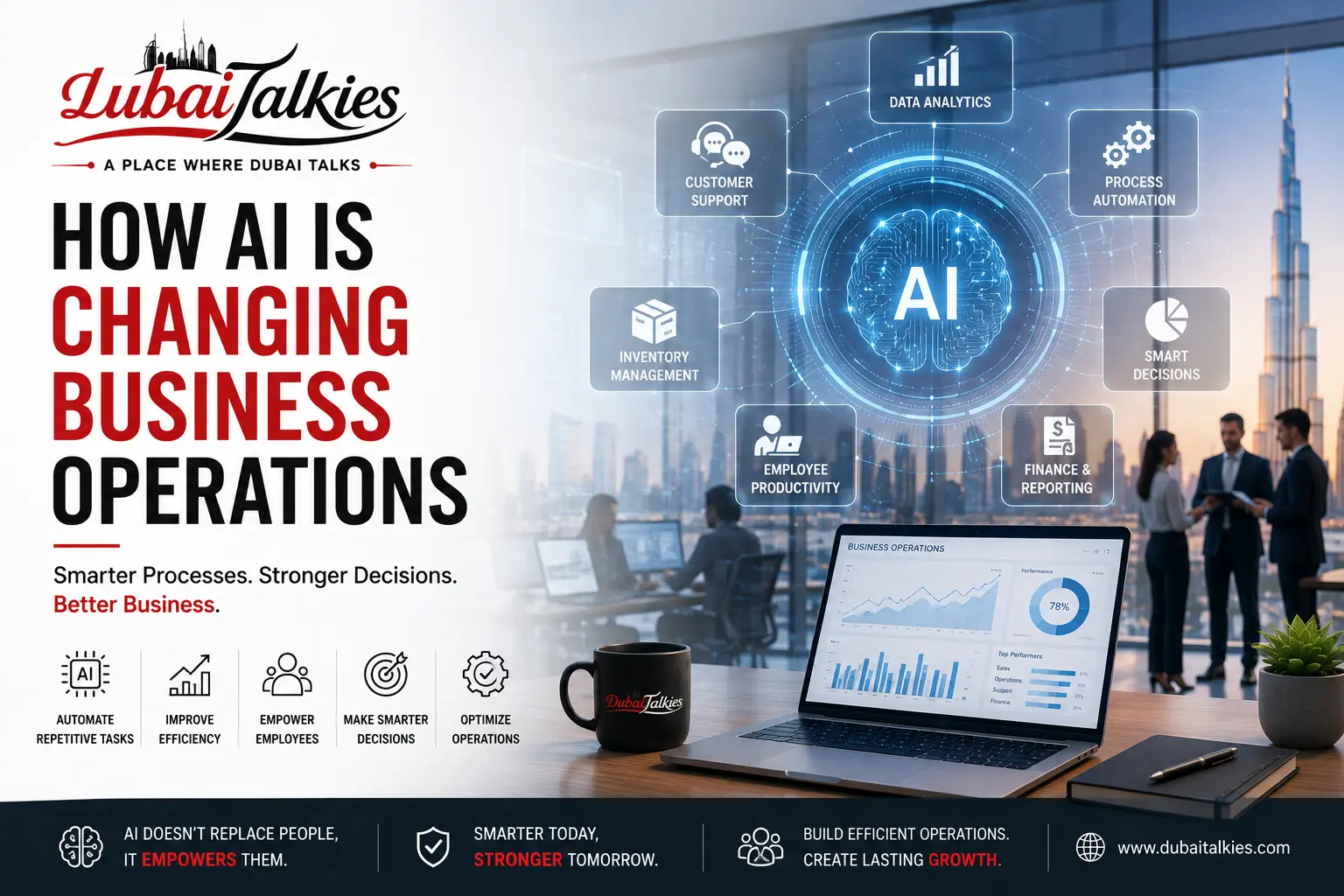
Artificial intelligence is no longer something businesses can treat as a technology for the future. AI is already changing how companies manage everyday operations, communicate with customers, organise information, support employees, and make business decisions.
For a business owner, the important question is not simply whether AI should be used. The real question is where AI can make the business faster, more efficient, and easier to manage without removing the human judgement that makes a company successful.
From startups and small businesses to large companies operating across Dubai and the UAE, artificial intelligence can now support many activities that previously required significant amounts of manual work.
AI can help businesses process information, automate repetitive tasks, analyse data, assist employees, manage customer enquiries, improve forecasting, and identify operational problems before they become larger issues.
This is part of a wider change in how businesses operate. Companies are becoming increasingly dependent on technology to manage information and customer relationships, which also makes having a strong digital business identity increasingly important. A business needs to be clearly represented across the platforms where customers, partners, suppliers, and professionals discover it.
Business operations include almost everything required to keep a company running.
This can include customer service, finance, administration, sales support, inventory management, procurement, employee management, scheduling, reporting, documentation, internal communication, and many other activities.
Traditionally, many of these processes depended heavily on employees performing repetitive tasks manually.
AI is changing that model.
Instead of simply following a fixed instruction, modern AI systems can process information, recognise patterns, understand language, generate responses, and provide recommendations based on the information available to them.
For example, a traditional automated system may send the same confirmation message every time a customer submits an enquiry. An AI-assisted system can analyse the enquiry, understand its subject, classify it, summarise the customer's requirement, and help the appropriate employee decide what action should be taken.
The technology is therefore becoming more useful for businesses that need to process large amounts of information every day.
The biggest reason businesses are exploring AI is efficiency.
Employees often spend a significant amount of time on tasks that are necessary but repetitive. Reading documents, organising information, preparing reports, responding to common questions, scheduling meetings, checking records, and transferring information between systems can consume hours every week.
AI can assist with many of these activities.
When repetitive work is reduced, employees can spend more time on activities that require communication, creativity, problem-solving, negotiation, and decision-making.
This does not mean that every business needs to automate everything.
In fact, businesses that try to introduce AI into every department at once can create unnecessary costs and confusion. A better approach is to identify specific operational problems and determine where AI can provide measurable value.
Repetitive work is one of the easiest areas where businesses can begin experimenting with artificial intelligence.
An AI system can help summarise documents, extract information from files, organise data, classify enquiries, prepare reports, generate internal drafts, and assist employees with information retrieval.
Consider a company that receives hundreds of customer enquiries every month.
Employees may have to read each enquiry, identify the customer's requirement, categorise it, assign it to the right person, and prepare a response.
AI can assist with several of these steps.
The employee can then focus on the quality of the final communication instead of spending most of the time performing administrative work.
This approach can be particularly useful for growing businesses where the volume of work increases faster than the size of the team.
Customer expectations have changed significantly.
People want businesses to respond quickly when they have questions about products, services, appointments, pricing, availability, delivery, or other information.
AI can help businesses respond to common questions without requiring an employee to answer every enquiry manually.
An AI-powered customer service system can provide answers to frequently asked questions, organise incoming enquiries, identify urgent requests, and direct complicated conversations to human employees.
The human element remains important.
Customers dealing with complex complaints, high-value purchases, sensitive issues, or specialised requirements may still need direct communication with a knowledgeable employee.
The strongest approach is therefore not always AI versus humans. It is often AI working with employees.
Every business collects information.
Sales figures, customer enquiries, expenses, inventory levels, employee information, operational reports, and other data can provide valuable insights into how a company is performing.
The problem is that businesses often have more information than their teams have time to analyse.
AI can process large amounts of information much faster and identify patterns that may otherwise be difficult to notice.
For example, an AI system could identify products that consistently perform well during particular periods. It could highlight unusual changes in expenses or identify common problems mentioned in customer enquiries.
Management can then use these insights when making decisions.
AI does not replace business judgement. Instead, it can give decision-makers better information to work with.
Inventory can become increasingly difficult to manage as a business grows.
Too much inventory can increase storage costs and tie up capital. Too little inventory can create delays and lost sales.
AI can analyse previous sales, purchasing patterns, seasonal changes, inventory levels, and other information to help businesses estimate future demand.
A company can use these insights to identify when stock may need to be replenished or which products could experience increased demand.
This can help businesses reduce unnecessary inventory while maintaining better product availability.
For companies with large product catalogues, AI-powered forecasting can become an important operational advantage.
Financial administration contains many repetitive activities.
Businesses regularly deal with invoices, receipts, expenses, payment information, financial documents, and internal reports.
AI can assist employees by extracting information from documents, organising records, categorising expenses, identifying unusual transactions, and preparing information for review.
For example, instead of manually entering information from hundreds of invoices, an AI-assisted system can extract supplier names, invoice numbers, dates, amounts, and other relevant information.
The finance team can then review the information instead of spending most of its time entering it.
Human oversight remains essential, particularly when financial information is used for important business decisions.
Human resources is another area where AI can reduce repetitive administrative work.
Recruitment teams may need to process applications, organise candidate information, schedule interviews, prepare communication, and manage large amounts of documentation.
AI can assist with organising and summarising this information.
However, businesses need to be careful when using AI in recruitment.
Hiring decisions involve people and can have significant consequences. An AI system should not automatically determine whether someone is suitable for employment without appropriate human review.
AI can support HR professionals, but human judgement should remain an important part of the process.
One of the biggest opportunities presented by AI is not replacing employees but helping them work more effectively.
An employee may use AI to summarise a long document, organise meeting notes, analyse information, prepare a first draft, translate material, research a subject, or structure a report.
These activities can reduce the time required for routine knowledge work.
The employee still provides the experience, context, judgement, and final approval.
This is why the discussion around AI automation vs hiring employees needs to go beyond simply asking whether AI will replace workers. For many businesses, the more useful question is how AI can help existing employees accomplish more.
As businesses grow, communication between departments can become increasingly complicated.
Sales may need information from finance. Customer service may need information from operations. Management may require updated reports from several departments.
Employees can lose valuable time searching through emails, documents, folders, and internal systems.
AI can help businesses organise and retrieve information more efficiently.
An internal AI assistant, for example, could help employees locate company policies, product information, procedures, previous reports, or other internal documents.
This can make information easier to access and reduce unnecessary delays.
Traditional business management often focuses on what has already happened.
AI allows companies to analyse historical information and identify patterns that may provide clues about what could happen next.
Businesses can use predictive systems for areas such as demand forecasting, inventory planning, equipment maintenance, customer behaviour, workforce scheduling, and operational risk.
For example, a company could analyse equipment data to identify patterns associated with potential maintenance problems.
A retailer could analyse previous sales to anticipate demand.
A service company could analyse appointment patterns to improve employee scheduling.
Predictions are never guaranteed, but they can give businesses more information when planning for the future.
AI is not only useful for large corporations.
Small businesses can also use artificial intelligence to reduce administrative work and improve how their teams operate.
A consultancy could use AI to organise meeting notes and prepare reports. A restaurant could analyse customer feedback to identify common issues. A real estate company could organise property information and assist agents with enquiries.
For a small business with limited employees, saving even a few hours each week can make a meaningful difference.
This is particularly important for startups and SMEs where employees often manage multiple responsibilities at the same time.
As businesses become more technology-driven, customers are also interacting with companies through more digital touchpoints.
A customer may discover a company through a business platform, visit its website, look at its services, check its company information, compare it with competitors, and then contact the business.
This is why a clear professional online presence matters.
A company's identity should be consistent and understandable wherever customers encounter it.
AI can improve the operational side of a business, but customers still need to know who the company is, what it does, and why they should trust it.
For businesses building this wider presence, platforms such as dubaitalkies can provide another place where companies can present their business information, services, products, and professional identity.
This is one of the biggest questions surrounding artificial intelligence.
The answer depends on the type of work involved.
AI can automate certain repetitive tasks very effectively. However, many business responsibilities require communication, leadership, creativity, negotiation, emotional understanding, physical activity, and professional judgement.
These areas cannot simply be replaced by software.
For many businesses, the better strategy is to identify which tasks should be automated and which responsibilities should remain human-led.
This creates a more balanced operating model where technology handles repetitive processes while employees concentrate on higher-value work.
AI should not be introduced simply because competitors are using it.
Businesses should first identify a specific problem.
If employees are spending too much time preparing reports, processing documents, answering repetitive questions, or organising information, that may be an appropriate area to investigate.
The company should then evaluate the available technology and determine whether the expected improvement justifies the cost.
Data protection is also important.
Businesses may handle customer information, financial records, contracts, employee information, and confidential documents. Before sending this information to an AI system, companies need to understand how the data is processed, stored, and protected.
Employees should also receive proper training.
A tool is only useful when people understand how to use it correctly.
Businesses do not need to transform their entire operation overnight.
A practical starting point is to identify one repetitive process that consumes significant employee time.
The company can introduce an AI solution, measure how much time or effort it saves, collect feedback from employees, and improve the process.
If the results are positive, the business can gradually introduce AI into other suitable areas.
This controlled approach allows companies to learn what works without making large investments before understanding the actual benefits.
AI will likely become increasingly integrated into everyday business software.
Instead of using separate tools for individual tasks, businesses may eventually operate connected systems where information moves between departments automatically.
A customer enquiry could be received, classified, assigned to the correct employee, and connected with relevant customer information.
Inventory systems could use demand forecasts to support purchasing decisions.
Management systems could analyse operational data and highlight areas that require attention.
The businesses that benefit most from this development will not necessarily be the ones using the largest number of AI tools.
They will be the companies that understand their operational challenges and use technology to solve the right problems.
Artificial intelligence is changing business operations in practical ways.
It can help companies reduce repetitive work, support employees, improve customer service, organise information, analyse data, forecast demand, and make business processes more efficient.
However, AI should not be viewed simply as a replacement for people.
The greater opportunity is to combine artificial intelligence with human experience, judgement, creativity, and communication.
For startups, SMEs, and established companies, the journey can begin with a single operational problem. Once businesses understand where AI creates genuine value, they can gradually build more efficient and scalable processes.
As technology continues to evolve, businesses that learn how to work effectively with AI will have an opportunity to operate faster, make better-informed decisions, and create stronger foundations for long-term growth.
AI is helping businesses automate repetitive tasks, process information faster, support employees, improve customer service, analyse data, and make better-informed operational decisions.
AI can automate certain repetitive tasks, but it does not replace the human judgement, creativity, communication, leadership, and decision-making required in many business roles. In many cases, AI works best as a tool that helps employees become more productive.
Small businesses can use AI for customer enquiries, document processing, reporting, scheduling, administrative tasks, data analysis, inventory planning, and internal information management without needing to build complex technology systems themselves.
AI can help businesses reduce repetitive work, improve efficiency, process information faster, support employees, identify operational patterns, improve forecasting, and potentially reduce delays and administrative costs.
A business should first identify a specific operational problem, evaluate whether AI is suitable for solving it, consider data security and privacy, train employees, and measure the results before expanding AI into other areas.













Comments
No comments yet. Be the first to comment!