
3 Free Reels From Your Existing Video - Creator Trial (Free)
September 16, 2026











© Dubai Talkies. All rights reserved by zubaaly management LLC.
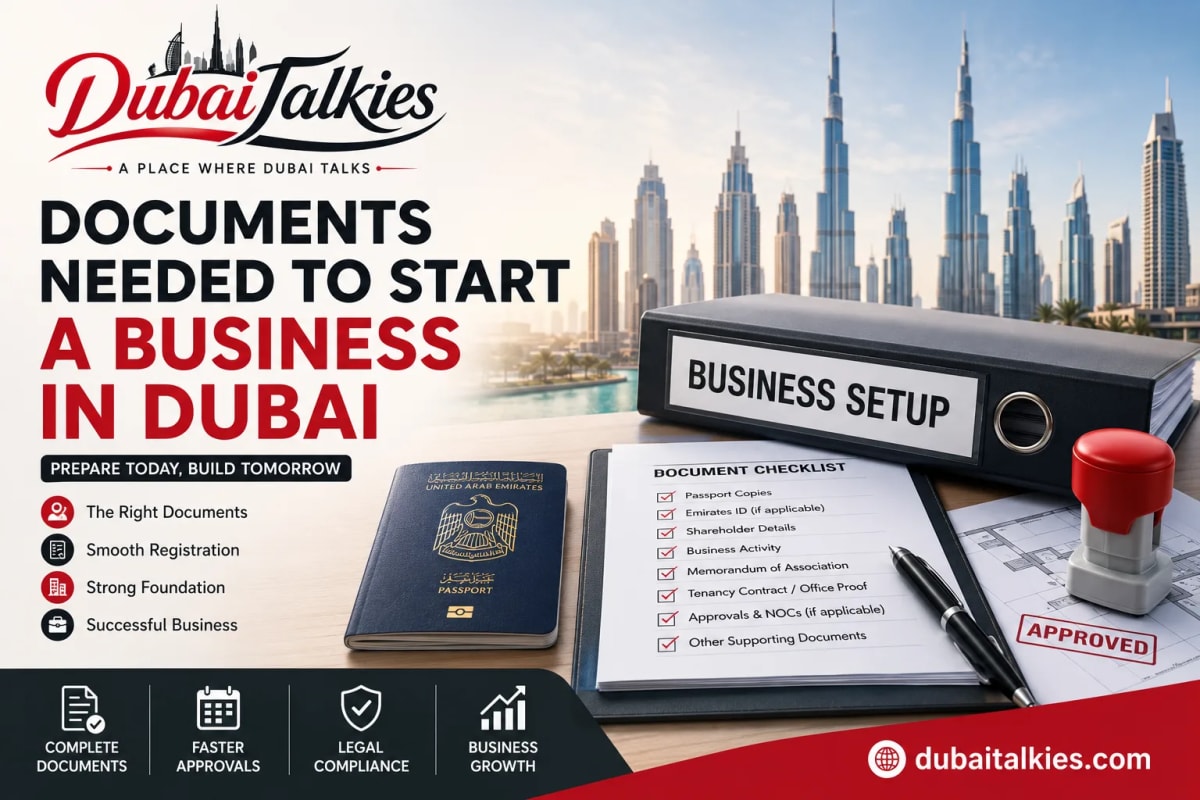
A business idea can take weeks or months to develop, but turning that idea into a registered company often begins with something much less exciting: paperwork.
For entrepreneurs planning to start a business in Dubai, preparing the right documents early can make the setup process considerably easier. The exact paperwork is not identical for every company. A consultant working from a small office may have a very different requirement from a restaurant, trading company, technology business or manufacturing operation.
The difference usually comes down to three things: what the business does, who owns it and where it is being established.
This is why copying another company's document checklist can sometimes create more confusion than clarity. Instead, entrepreneurs should understand the purpose of the main documents and then identify which ones apply to their particular setup.
If you are still deciding what kind of company you want to establish, it is also useful to understand business licenses in Dubai before preparing the final paperwork. The type of activity and license can influence what comes next.
Before collecting documents, define the business itself.
What will you sell? Will you provide a professional service? Will customers visit your premises? Will you import products? Will you employ staff? Will the company have one owner or several shareholders?
These questions matter because company formation is not a completely uniform process.
For example, a consultant may mainly need personal identification and company formation information, while a food-related business could have additional requirements connected with its premises and approvals.
The first useful document, therefore, is not actually a document at all. It is a clear description of the proposed business activity.
Once that is established, the rest of the preparation becomes much more straightforward.
For individual shareholders, the passport is one of the most fundamental pieces of information used during company formation.
A clear passport copy may be required for each relevant shareholder or owner. If the company has several individual shareholders, information for each person may need to be submitted.
Existing UAE residents may also need to provide their Emirates ID for applicable procedures.
The important thing is consistency. Names, dates of birth and other personal details should match across the documents being submitted.
A surprisingly simple issue such as an unclear scan or inconsistent personal information can result in additional requests and delays.
Before starting an application, create a digital folder containing clear, readable copies of all current identification documents.
Your proposed business name is another important part of the setup process.
The name customers know you by may eventually become one of your most valuable brand assets, so it should not be selected casually.
Entrepreneurs should first check the applicable naming rules and whether the proposed name can be registered under the chosen jurisdiction.
It is worth preparing more than one suitable option in case the preferred name is unavailable or does not meet the applicable requirements.
This is also a good moment to think beyond registration. A company name should ideally work across its website, social media profiles, marketing materials and customer communications.
A legally acceptable name and a strong commercial brand are not always the same thing.
Authorities need to understand who owns the company.
For a business with one individual owner, this can be relatively straightforward. Multiple shareholders can introduce additional documentation and information.
The application may require details about ownership percentages, managers, authorized representatives and the legal structure of the company.
If another company is investing in or owning the new business, the paperwork can become more involved. Corporate shareholders may need to provide documents proving their existence, ownership and authority to participate in the new company.
This is one reason international investors should start gathering corporate records early rather than waiting until the application is already underway.
Depending on the chosen legal structure and jurisdiction, formal company documents may be required to establish how the business is organized.
One example is the Memorandum of Association, commonly known as an MOA.
Such documents can contain important information about the company and its ownership arrangements.
However, entrepreneurs should not assume that every business uses exactly the same formation documentation. Requirements can vary according to the type of company and the authority responsible for registration.
The safest approach is to obtain the document requirements for the specific structure rather than downloading a generic template from the internet and assuming it will be accepted.
One of the most important parts of the application is explaining what the company will actually do.
This may sound straightforward, but vague descriptions can create problems later.
A company might describe itself as a “business services company,” while its actual work includes consulting, marketing, recruitment, technology services or another specific activity.
The licensed activity should accurately represent the business.
This matters not only during registration but also after the company starts operating. If the business later expands into a substantially different service, the owner may need to check whether the existing setup covers that activity.
Choosing the right activity at the beginning can therefore prevent unnecessary changes later.
Your business location can affect the documentation you need.
A company operating from a commercial office may have premises-related requirements. A retail store, restaurant, warehouse or workshop can have additional considerations because the physical location is directly connected to the activity.
Depending on the setup, entrepreneurs may need to provide tenancy or other premises-related documentation.
This is an area where rushing can be expensive.
Before committing to a property, business owners should establish whether the location is suitable for the intended activity and whether the relevant authority's requirements can be satisfied.
Signing a lease first and discovering later that the premises are unsuitable can create unnecessary financial pressure.
Not every business can be registered using only basic identification and incorporation paperwork.
Certain industries operate under additional regulatory requirements.
A business working in a regulated field may need approval, certification, qualification evidence, inspection or other documentation from the relevant authority.
The reason is simple: the government is not only registering the company; it may also need to confirm that the company is capable and authorized to perform the particular activity.
This can apply to sectors such as healthcare, education, food-related businesses, tourism, financial activities and other specialized fields.
If your proposed business falls into a regulated category, find out about these requirements before finalizing the setup plan.
Business owners do not always complete every formation step personally.
An authorized representative, consultant or other permitted party may handle parts of the process.
In such circumstances, evidence of authorization may be required.
Depending on the situation, this could involve a Power of Attorney or another accepted authorization document.
The key consideration is making sure that the person submitting documents has the appropriate authority to act for the owner or company.
Entrepreneurs should keep copies of any authorization documents they sign and understand exactly what authority has been granted.
International entrepreneurs can encounter another layer of paperwork when documents originate outside the UAE.
A foreign company's incorporation certificate, shareholder documentation or other official records may require additional formalities depending on the application.
In some circumstances, documents may need certification, legalization, notarization or translation.
The requirement is not automatically the same for every foreign document.
This is why entrepreneurs should avoid paying for document attestation or translation without first confirming that the specific document requires it.
Checking first can save both time and money.
A common source of confusion is the assumption that there is one universal Dubai business setup checklist.
There isn't.
A mainland business and a free-zone company operate through different jurisdictions and can have different procedures.
Even two businesses operating in different free zones may not have identical requirements.
The same principle applies to business activities. A consultancy and an industrial operation can require very different supporting documents.
So if a friend, colleague or online article gives you a checklist, treat it as a reference rather than a guaranteed list for your own application.
Your licensing authority and business activity should determine the final requirements.
Entrepreneurs can make their own lives easier by organising documents before the application begins.
Create a dedicated folder containing:
Passport copies
Emirates ID documents where applicable
Shareholder information
Proposed company names
Business activity details
Formation documents
Premises information where required
Manager or authorized representative documents
Corporate shareholder records where applicable
Professional certificates or qualifications where required
External approval documents where applicable
Use clear file names and keep the latest version of each document.
It is also sensible to keep both editable information and final signed copies where appropriate.
This may seem like a minor administrative task, but it becomes useful when several parties are involved in the setup.
Company formation is not necessarily the end of your documentation responsibilities.
Once the business begins operating, other processes can create their own documentation requirements.
Hiring employees, applying for visas, changing shareholders, moving premises, adding business activities, entering certain regulated sectors or expanding operations can all introduce additional procedures.
This means entrepreneurs should treat documentation as an ongoing part of business administration rather than something that disappears after receiving the license.
Keeping company records organized from the beginning makes future changes much easier to manage.
Most entrepreneurs do not deliberately submit incorrect paperwork. Problems usually happen because something was overlooked.
An expired identification document can cause a delay. A blurry scan can require resubmission. A company may discover that an activity needs additional approval only after the application has started.
Another common problem is using an old checklist that no longer reflects the current requirements.
The solution is simple: verify before submitting.
Check that the documents are current, the information matches, the business activity is accurate and any special requirements have been identified.
If the setup involves unusual ownership arrangements or a regulated activity, professional guidance can also be useful.
Once the relevant documents have been prepared, the application can move forward through the appropriate licensing or company-formation process.
The exact sequence depends on the jurisdiction, activity and legal structure.
But receiving the company's documents is only the beginning of running a business.
After registration, the owner still needs to think about accounting, operations, customer service, sales, marketing and visibility.
This is where many entrepreneurs make a second mistake: they spend so much effort getting the company established that they have no customer-acquisition plan ready for launch.
There is little value in having perfectly organised company documents if potential customers cannot find the business.
Before launch, entrepreneurs should already be thinking about their website, search visibility, social profiles, business listings and customer communication channels.
A new company can begin building its digital footprint even while the operational side is being prepared.
For businesses targeting customers in Dubai, appearing on relevant discovery platforms can also help introduce the company to people actively looking for local products and services.
Dubaitalkies allows Dubai-based businesses to present their company, products and services in one business discovery environment.
The paperwork involved in starting a business should not be viewed as a mountain of forms.
Think of it as a sequence.
First, establish what the business will do. Then decide the appropriate jurisdiction and structure. Identify the owners and representatives. Prepare the relevant personal and corporate documents. Check premises requirements. Identify external approvals. Finally, confirm the current checklist with the authority handling the application.
This approach is much safer than collecting random documents and hoping they will be enough.
It also helps entrepreneurs understand why each document exists rather than simply treating the process as administrative work.
Starting a business in Dubai requires preparation, and documentation is one of the areas where a little organization can prevent a lot of frustration.
There is no universal folder of documents that works for every entrepreneur. A consultant, online seller, restaurant owner, technology company and international investor can all face different requirements.
The most important step is to begin with the business activity and ownership structure, then build the documentation around those details.
Keep identification records current, prepare company information carefully, check whether the premises require supporting documents, and investigate additional approvals before they become a last-minute problem.
Once the paperwork is sorted, turn your attention to the next challenge: getting your business noticed.
A new company needs more than legal registration. It needs customers who can discover it, understand its offer and trust it enough to make contact.
Set up correctly. Get discovered. Build trust. Grow with purpose.
For Dubai businesses looking to improve their visibility and reach potential customers, Dubaitalkies provides a dedicated platform for discovering businesses, products and services.
Discover businesses on Dubaitalkies.
Common documents include passport copies, Emirates ID where applicable, shareholder details, proposed business name, business activity information and relevant company formation documents. Additional documents may be required depending on the activity and jurisdiction.
It depends on the business structure, licensing authority and activity. Some businesses may require tenancy or premises-related documents, while certain setups can have different office arrangements.
Yes. Businesses operating in regulated sectors may need approvals, professional qualifications, certificates, inspections or other documents from the relevant authorities.
They may. If a shareholder or parent company is based outside the UAE, certain corporate or personal documents may require certification, legalization, notarization or translation depending on the application.
No. Mainland and free-zone companies can have different application procedures and document requirements. The exact checklist depends on the licensing authority, business activity and company structure.
Disclaimer: This article is provided for general informational purposes only. Business setup and document requirements can change and may differ according to the licensing authority, business activity, legal structure, ownership and individual circumstances. Always verify the latest requirements with the relevant UAE government or licensing authority before submitting documents or making business decisions













Comments
No comments yet. Be the first to comment!