
3 Free Reels From Your Existing Video - Creator Trial (Free)
September 16, 2026











© Dubai Talkies. All rights reserved by zubaaly management LLC.
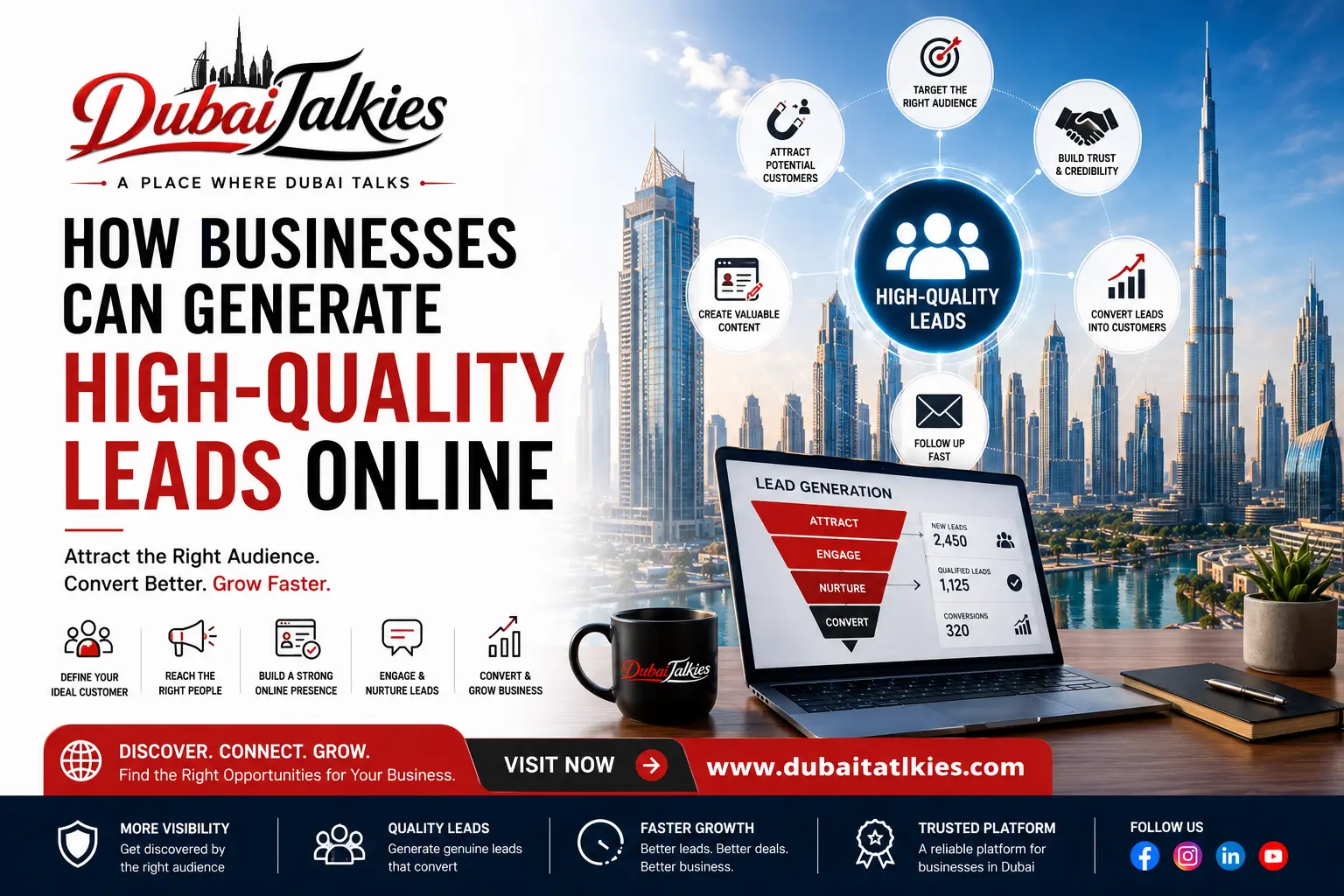
Generating leads online is no longer simply about getting more people to visit a website. For businesses, the real challenge is attracting the right people—potential customers who have a genuine need, understand the value of the product or service, and are more likely to start a conversation or make a purchase.
A business can receive thousands of website visitors and still generate very few customers if those visitors are not relevant. On the other hand, a smaller but highly targeted audience can produce stronger enquiries and better business results.
This is why modern businesses are increasingly focusing on lead quality rather than lead quantity.
Whether you operate a local business, professional service, startup, SME, e-commerce company, real estate business, consultancy, restaurant, healthcare company, or B2B organisation, building a reliable online lead-generation system can create a consistent path between potential customers and your sales team.
A high-quality lead is a potential customer who has a strong possibility of becoming a paying customer.
The person may already be looking for a particular product or service, have a suitable budget, operate within your target market, or have a specific problem that your business can solve.
For example, a person searching for a restaurant and simply browsing different options may not immediately become a customer. A person looking for a restaurant to host a corporate dinner tomorrow has a much stronger buying intention.
The difference is intent.
High-quality lead generation therefore begins with understanding who your ideal customer is and what motivates that customer to contact a business.
Many businesses create an online presence but do not build a complete journey for potential customers.
A visitor may discover a company but fail to understand its services. Another person may be interested but cannot find contact information quickly. Someone else may submit an enquiry but never receive a response.
Lead generation can therefore fail at several stages.
The problem may not always be a lack of traffic. It can be unclear business information, weak positioning, poor enquiry processes, limited trust signals, slow responses, unsuitable audiences, or a lack of follow-up.
Businesses should look at the entire customer journey rather than focusing on one channel.
Before trying to generate more leads, a business should understand exactly who it wants to attract.
A company selling accounting services to established SMEs, for example, should not communicate in exactly the same way as a company offering basic bookkeeping to freelancers.
The target customer may differ by industry, location, company size, budget, requirements and purchasing behaviour.
Creating a clear customer profile helps businesses decide what information to publish, which platforms to use and what type of enquiries should be prioritised.
For Dubai businesses, location can be particularly important. A company may want customers from Downtown Dubai, Business Bay, JLT, Dubai Marina, Deira, Al Quoz or another specific area depending on where it operates.
A more precise audience generally creates better opportunities for relevant enquiries.
Before contacting a company, potential customers often want to understand whether the business is legitimate and suitable for their requirements.
A professional online business profile should clearly communicate what the company does, who it serves and how customers can contact it.
Important information can include the business name, description, services, products, location, contact details, operating hours, photographs, social profiles and other relevant information.
The goal is simple: a potential customer should not have to search across several platforms to understand the business.
This is also where a professional digital business identity becomes valuable. Businesses can learn more about this concept in our related guide, Why Every Business Needs a Digital Business Identity.
A common reason businesses lose potential leads is that their services are unclear.
A company may describe itself as a "full-service business solutions provider," but a potential customer may still not understand what it actually offers.
Clear service descriptions can make the decision process easier.
Instead of relying on generic statements, explain the problem the service solves, who it is designed for and what customers can expect.
For example, a logistics company could clearly explain whether it provides freight forwarding, warehousing, customs clearance, last-mile delivery or supply chain management.
The more clearly a customer understands the offer, the easier it becomes to decide whether to make an inquiry.
Potential customers rarely begin every buying journey by contacting a company immediately.
They may first search for information.
Someone considering a property purchase may research locations, prices and developers. A restaurant customer may compare menus and reviews. A business owner may research different service providers before requesting a quotation.
Businesses can use this behaviour to create useful informational content.
Instead of constantly promoting the company, answer the questions customers are already asking.
This can include guides, comparisons, explanations, checklists, industry insights and practical information.
Useful content can attract people earlier in their decision-making process and gradually introduce them to the business.
Businesses should not depend entirely on their own website to generate enquiries.
Business directories and business discovery platforms can provide another way for customers to discover companies.
A well-maintained business profile can help a company present its services, location, contact information and other important details in one place.
For businesses operating in Dubai, platforms focused specifically on local businesses can be particularly useful because customers are often searching according to both service and location.
Dubaitalkies, for example, is designed as a Business Social Platform where businesses can create profiles and become easier for customers and other businesses to discover.
A customer searching for "accounting company in Dubai" is different from someone casually reading an article about accounting.
The first person may already have a specific requirement.
Businesses should therefore make sure that their online profiles and pages clearly match the services customers are looking for.
This means using straightforward descriptions rather than complicated company language.
When someone arrives at a business profile, they should quickly understand:
What does this business provide?
Where does it operate?
Who does it serve?
How can I contact it?
Answering these questions reduces friction and can increase the likelihood of an enquiry.
Not every potential customer prefers the same communication method.
Some people prefer phone calls. Others may use WhatsApp, email, contact forms or social media messaging.
Businesses can make the enquiry process easier by providing appropriate contact options.
However, the objective should not be to overwhelm visitors with dozens of buttons.
The most important contact methods should be easy to find and work properly.
A customer who has to search for a phone number or wait several minutes for a form to load may simply move to another company.
A potential customer should know what to do next.
A page can provide excellent information but still generate few enquiries if there is no clear next step.
Depending on the business, calls to action can include:
Request a Quote
Book a Consultation
Contact the Business
Get Pricing
Ask a Question
Schedule a Call
Send an Enquiry
The call to action should match the customer's stage in the buying journey.
Someone researching a service may prefer to ask a question, while someone who already understands the service may be ready to request a quotation.
People are more likely to contact businesses they trust.
Trust can be created through genuine customer reviews, business information, professional photographs, credentials, certifications, case studies, clear contact details and consistent company information.
Businesses should also avoid making unrealistic claims.
Statements such as "the best company in Dubai" are less useful than specific information showing why customers should consider the company.
Transparency can be a stronger trust signal than exaggerated marketing language.
Reviews can influence how potential customers compare businesses.
A customer may look at several companies before deciding which one to contact.
Businesses should therefore encourage genuine customers to leave honest feedback where appropriate.
The goal should not simply be to collect a large number of reviews. Businesses should also pay attention to recurring feedback.
If customers repeatedly mention slow responses, unclear pricing or delivery problems, those issues may be reducing lead conversion.
Reviews can therefore provide both a trust signal and a source of business improvement.
Generating a lead is only the beginning.
A potential customer may contact several businesses at the same time. The company that responds clearly and professionally may have a better opportunity to continue the conversation.
Businesses should establish a process for monitoring enquiries and responding within a reasonable timeframe.
A simple response can acknowledge the enquiry, confirm the requirement and explain the next step.
A fast response does not mean sending an automated message and forgetting about the customer. Personal follow-up remains important when the enquiry has genuine buying intent.
Not every enquiry is equally valuable.
Sales teams can use simple qualification questions to understand whether a lead matches the business.
Depending on the industry, this could include the customer's location, service requirement, budget, project size, timeframe or business type.
Qualification helps sales teams prioritise serious prospects without treating every enquiry exactly the same way.
For example, a property service provider may prioritise a customer who has already selected a location and budget over someone who is only beginning to research the market.
Marketing and sales should not operate as completely separate activities.
The information collected during the lead-generation process should help the sales team understand where the potential customer came from and what they are interested in.
A simple system can track enquiries from initial contact through follow-up and eventual conversion.
This allows businesses to identify which sources generate genuine opportunities rather than simply counting enquiries.
A business generating 100 enquiries may appear to be performing better than one generating 30.
But what if only two of those 100 enquiries become customers while ten of the 30 become customers?
The second business is generating fewer leads but potentially achieving a much stronger result.
Businesses should therefore monitor metrics such as qualified leads, enquiry-to-customer conversion, response time, repeat enquiries and revenue generated from different lead sources.
This creates a more accurate picture of online performance.
There is rarely one perfect source of leads.
A business can generate opportunities through its website, business profiles, social platforms, referrals, online communities, content, email communication and paid campaigns.
Different sources can serve different stages of the customer journey.
For example, informative content can attract people researching a problem, while a detailed business profile can help customers compare providers. Direct enquiries can then move qualified prospects into the sales process.
The strongest systems connect these different touchpoints rather than relying on a single source.
Modern customers often compare several companies before making a decision.
They may compare services, prices, locations, reviews, experience, responsiveness and overall credibility.
Businesses should therefore make important information easy to find and understand.
A complete business profile gives potential customers enough information to decide whether they want to take the next step.
This is especially important in competitive markets where customers have many alternatives.
High-quality online lead generation is not about attracting the largest possible audience.
It is about attracting relevant people, giving them useful information, building trust and making it easy for them to start a conversation with your business.
Businesses that clearly define their target customers, maintain professional business profiles, provide useful information, create simple enquiry processes and follow up consistently can build a stronger foundation for sustainable lead generation.
For Dubai businesses, being discoverable where customers are actively researching companies can create additional opportunities to connect with relevant prospects.
Dubaitalkies provides businesses with another platform to build their professional presence, showcase their services and become discoverable within a growing business community.
The objective is not simply to generate more leads. It is to generate better leads—and turn the right opportunities into long-term customers.
Businesses can generate high-quality leads by clearly defining their target customers, maintaining a professional online business presence, providing useful information, making contact options easy to find, and following up quickly with relevant enquiries.
A high-quality lead is a potential customer who has a genuine need for the product or service and is a good match for the business based on factors such as location, budget, requirements, industry, or purchase timeframe.
Not necessarily. A smaller number of relevant leads can produce better results than a large number of enquiries from people who are unlikely to become customers. Businesses should focus on lead quality, qualification and conversion rather than enquiry volume alone.
A complete business profile can give potential customers important information about the company, including its services, products, location, contact details, images and other business information. This can help customers understand the company and decide whether to make an enquiry.
Potential customers may contact multiple businesses while comparing their options. Responding quickly and professionally can help a business maintain the customer's interest and move a genuine enquiry toward a sales conversation.







Comments
No comments yet. Be the first to comment!