
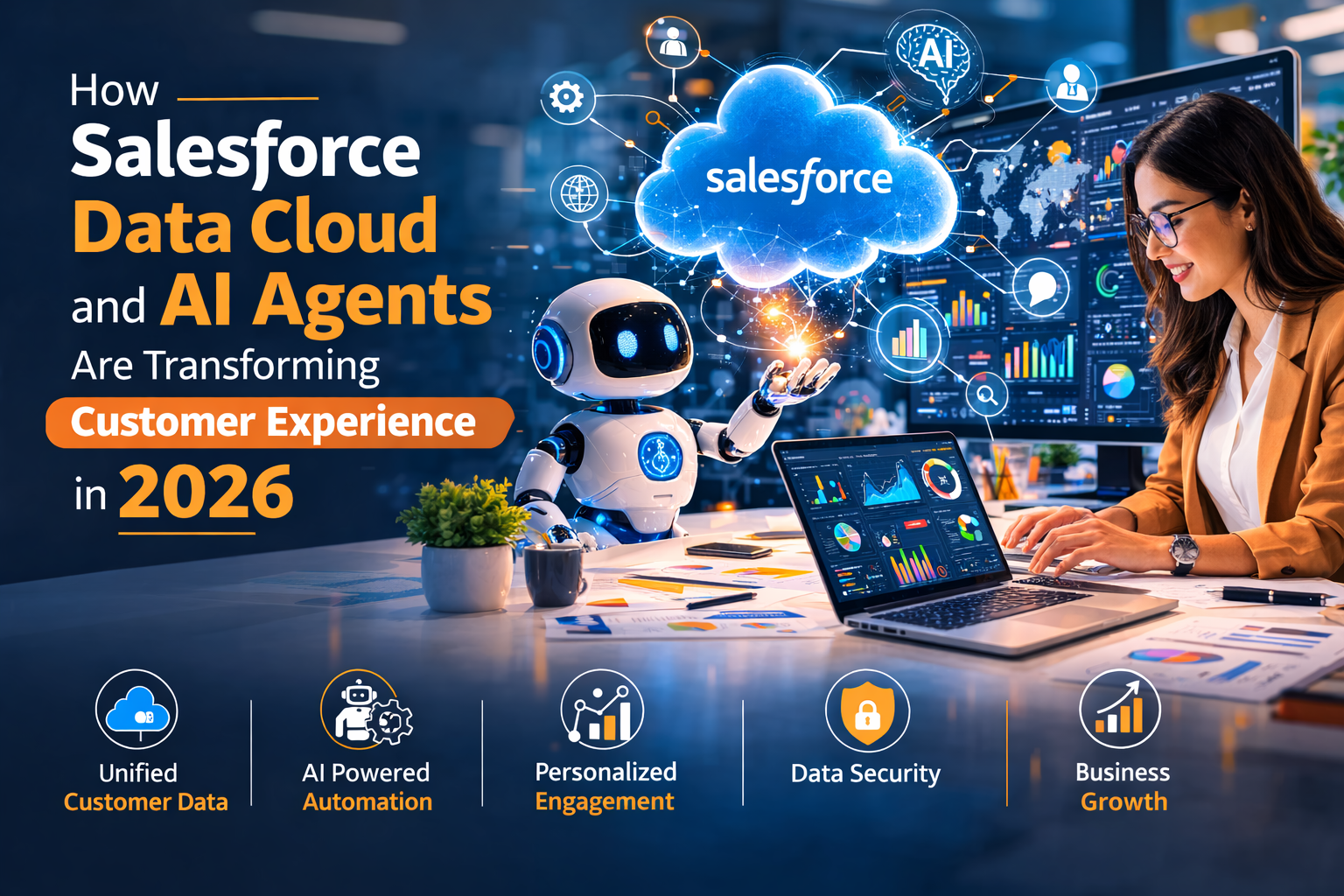










Customer expectations have undergone significant changes in recent years. Modern customers expect businesses to deliver personalized experiences, respond instantly to inquiries, and provide consistent communication across every digital channel. Meeting these expectations requires more than traditional customer relationship management systems.
Today, businesses need intelligent CRM platforms capable of analyzing large amounts of customer data, automating workflows, and predicting customer needs before they arise. Salesforce has taken a leading role in this transformation by introducing powerful innovations such as Data Cloud and AI-driven digital agents.
These technologies allow organisations to unify customer data from multiple systems, generate actionable insights, and automate interactions across sales, marketing, and customer service. As a result, companies can create smarter and more efficient customer engagement strategies.
For organizations seeking to remain competitive in a rapidly evolving digital economy, adopting modern Salesforce technologies is no longer optional. It is becoming a fundamental part of digital transformation strategies.
Understanding Salesforce Data Cloud
Salesforce Data Cloud is designed to solve one of the biggest challenges businesses face today: fragmented data. Many organizations store customer information in multiple systems including CRM platforms, marketing tools, support systems, and external databases. When data is scattered across different platforms, it becomes difficult to gain a complete understanding of customer behavior.
Salesforce Data Cloud provides a centralized platform where businesses can bring together customer data from various sources. By combining information from sales activities, marketing campaigns, customer support interactions, and external applications, the platform creates a unified customer profile.
This unified data environment enables businesses to gain a complete view of their customers. Instead of working with incomplete information, teams can access real-time insights about customer preferences, purchase history, and engagement patterns.
Having this comprehensive view allows organizations to make better decisions and deliver more relevant customer experiences.
The Rise of AI Agents in CRM
Artificial intelligence is playing an increasingly important role in modern CRM platforms. AI agents are intelligent digital assistants that can perform tasks traditionally handled by human employees. These agents analyze data, automate processes, and provide recommendations that help businesses operate more efficiently.
Within the Salesforce ecosystem, AI agents can assist teams in multiple ways. For sales departments, AI can automatically analyze lead behavior and identify prospects that are most likely to convert into customers. This allows sales representatives to focus their efforts on the most valuable opportunities.
In customer service environments, AI agents can respond to common customer inquiries, route cases to appropriate support teams, and recommend solutions based on historical case data. This reduces response times and improves customer satisfaction.
Marketing teams also benefit from AI automation. AI agents can analyze customer data and determine the best time and channel to deliver marketing messages, increasing the chances of engagement and conversion.
How Data Cloud and AI Work Together
The true power of Salesforce innovation lies in the combination of Data Cloud and AI technologies. While Data Cloud provides a unified data foundation, AI systems analyze this data to generate insights and automate decision-making processes.
When AI tools have access to unified customer data, they can identify patterns that might otherwise go unnoticed. For example, AI can analyze purchasing trends and predict when a customer is likely to make another purchase. Businesses can then send targeted promotions or recommendations at the right moment.
Similarly, AI-driven automation can detect potential customer churn by identifying changes in engagement behavior. If a customer stops interacting with a company’s services, the system can trigger proactive support or marketing campaigns to re-engage them.
By combining unified data with intelligent automation, Salesforce enables businesses to deliver highly personalized experiences at scale.
Improving Sales Performance with AI and Data Intelligence
Sales teams often spend a significant amount of time performing administrative tasks such as updating CRM records, generating reports, and managing follow-ups. These activities can reduce the time available for building relationships and closing deals.
AI-powered automation helps solve this problem by handling routine tasks automatically. Digital agents can update CRM records, track communication history, and schedule follow-up reminders without manual input.
Predictive analytics also play an important role in improving sales performance. By analyzing historical data and customer behavior, AI systems can predict which leads are most likely to convert into customers. Sales representatives can then prioritize these leads and focus their efforts on high-value opportunities.
As a result, businesses can increase sales productivity while improving overall conversion rates.
Enhancing Customer Service Through Intelligent Automation
Customer service has become a critical factor in building long-term customer relationships. Customers expect fast responses and seamless support experiences across digital channels such as email, chat, and social media.
AI-powered support tools enable businesses to meet these expectations. Intelligent chatbots and digital agents can handle routine customer inquiries, provide product information, and guide users through troubleshooting steps.
More complex issues can be automatically routed to the most appropriate support agent based on expertise and availability. This ensures that customers receive accurate assistance without unnecessary delays.
In addition, AI-driven knowledge systems can recommend solutions to service agents during customer interactions. By analyzing previous cases and documentation, the system provides relevant suggestions that help agents resolve issues faster.
These capabilities allow organizations to deliver efficient customer support while reducing operational costs.
Personalized Marketing with Unified Customer Data
Marketing strategies are becoming increasingly data-driven. Businesses must understand customer preferences and behaviors in order to deliver personalized messages that resonate with their audience.
Salesforce Data Cloud enables marketers to segment audiences based on detailed customer insights. Instead of sending generic campaigns, businesses can create targeted messaging tailored to specific customer segments.
AI automation further enhances marketing performance by analyzing campaign results and optimizing future strategies. For example, AI can determine which content formats generate the highest engagement and recommend improvements for future campaigns.
Automation tools also manage campaign execution across multiple channels, including email, social media, and mobile messaging. This ensures consistent communication and maximizes marketing efficiency.
Why Businesses Are Investing in Intelligent CRM Systems
Organizations across industries are recognizing the value of intelligent CRM platforms. Technologies such as Salesforce Data Cloud and AI agents offer several significant advantages.
First, they improve operational efficiency by automating repetitive tasks. Employees can focus on strategic activities rather than manual processes.
Second, unified data environments provide deeper customer insights. Businesses can understand customer behavior more accurately and make informed decisions based on real-time data.
Third, personalized experiences strengthen customer relationships. When companies deliver relevant content and responsive support, customers are more likely to remain loyal.
Finally, scalable automation allows businesses to grow without increasing operational complexity. As organizations expand, intelligent systems ensure processes remain efficient and consistent.
Conclusion
The future of customer relationship management is intelligent, automated, and data-driven. Salesforce is leading this transformation by combining powerful technologies such as Data Cloud and AI-powered digital agents.
These innovations enable organizations to unify customer data, automate workflows, and deliver personalized experiences across every stage of the customer journey. Businesses that adopt these technologies can improve efficiency, strengthen customer relationships, and drive sustainable growth.
For organizations seeking to remain competitive in a rapidly evolving digital landscape, implementing intelligent CRM systems is becoming a strategic priority. With the right Salesforce solutions and expertise, businesses can unlock new opportunities and build stronger connections with their customers.
Weekly trending


IHOP Dubai Chocolate Pancakes: Emirati-Inspired Delight
November 18, 2025Activities

Zegna Hosts Iconic Fashion Show at Dubai Opera
November 18, 2025Attractions


Atlantis The Palm Dubai | Luxury Hotel & Waterpark
November 18, 2025Hotels
Popular tags
Popular in dubai







Comments
No comments yet. Be the first to comment!
Leave a Comment