
3 Free Reels From Your Existing Video - Creator Trial (Free)
September 16, 2026











© Dubai Talkies. All rights reserved by zubaaly management LLC.
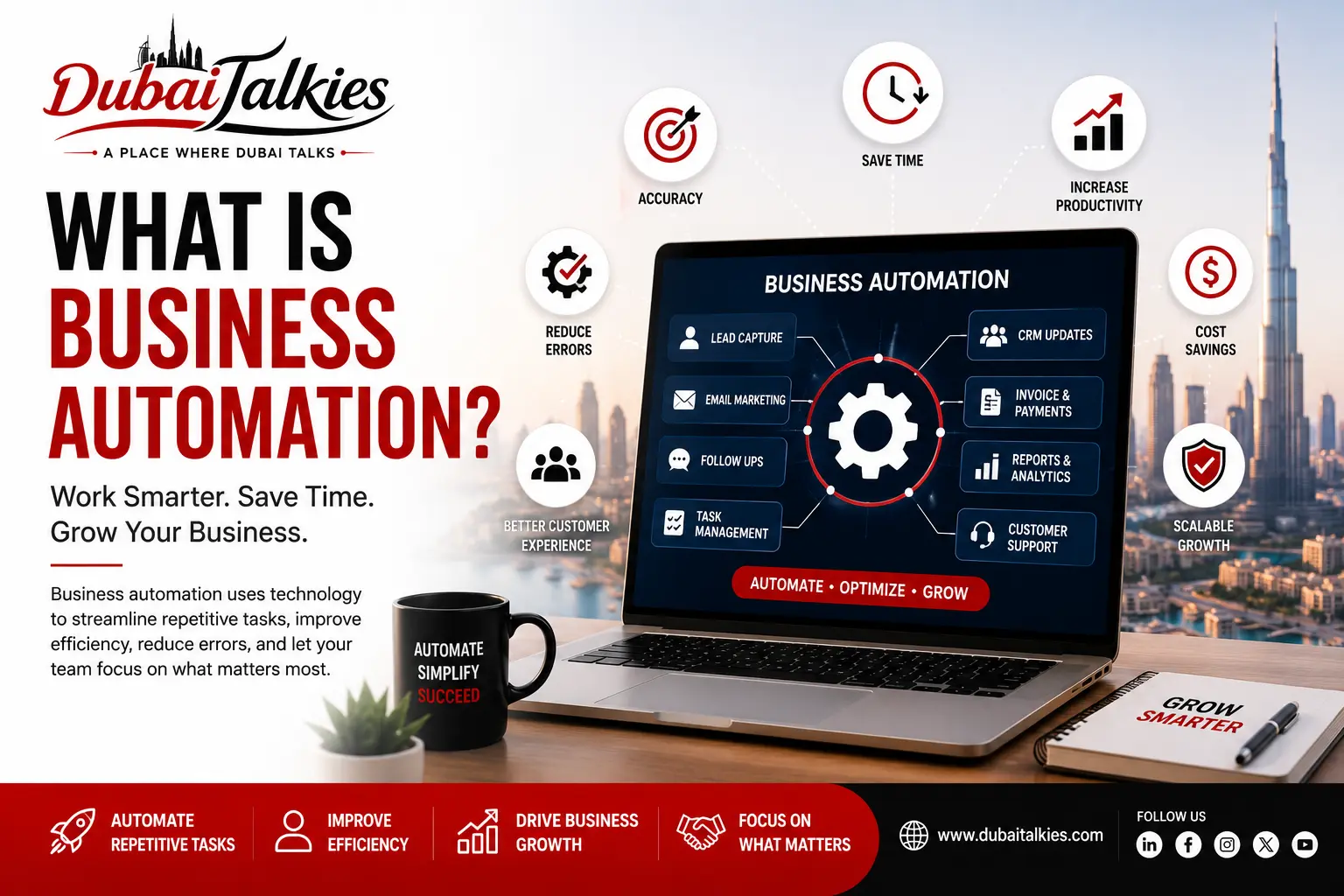
Business automation is the use of technology, software, and digital systems to perform repetitive business tasks with minimal manual involvement. Instead of employees repeatedly handling the same processes, automation allows businesses to create workflows that can execute specific activities automatically based on predefined rules or triggers.
From sending emails and following up with leads to managing customer information, generating reports, processing enquiries, scheduling appointments, and tracking marketing activities, automation can improve how businesses operate on a daily basis.
For startups, SMEs, and growing companies, business automation is becoming increasingly important because growth often creates more operational work. Without efficient systems, employees can spend significant amounts of time on repetitive activities instead of focusing on customers, strategy, sales, innovation, and business development.
Business automation means using technology to simplify or automatically complete processes that would otherwise require repeated human action.
A simple example is an online enquiry form. Without automation, an employee may need to check the website regularly, copy the customer's information into a spreadsheet, send a confirmation email, notify the sales team, and create a follow-up reminder.
With automation, the same process can happen automatically. Once a customer submits the form, the system can record the information, send a confirmation message, notify the relevant employee, and trigger a follow-up workflow.
The employee can then focus on responding to the customer rather than performing administrative steps.
Businesses generate large amounts of information and repetitive tasks every day. As the number of customers, employees, enquiries, transactions, and marketing activities increases, managing everything manually becomes more difficult.
Automation helps businesses create more structured processes.
It can reduce repetitive work, improve consistency, speed up responses, minimise certain human errors, and allow employees to spend more time on activities that require judgement and creativity.
Automation does not necessarily mean replacing employees. In many cases, the purpose is to give employees better tools so they can work more efficiently.
Business automation generally works through a combination of software, triggers, rules, data, and workflows.
A trigger starts the process. This could be a customer submitting a form, making a purchase, registering an account, sending an enquiry, booking an appointment, or completing another action.
The automation system then follows predefined rules. It may store information, send a notification, update a CRM, assign a task, send an email, or move the customer into another stage of a workflow.
The final result depends on how the business has designed the process.
For example, a website enquiry could automatically enter a CRM, notify a salesperson, send a confirmation email to the customer, and create a follow-up task.
Many repetitive processes can be automated across different departments.
Marketing automation can manage activities such as email campaigns, lead nurturing, customer segmentation, campaign notifications, and certain reporting processes.
Sales automation can help with lead assignment, follow-up reminders, CRM updates, quotation workflows, and customer communication.
Customer service automation can support enquiry routing, automated responses, appointment scheduling, and frequently requested information.
Finance teams can automate invoice reminders, payment notifications, recurring billing processes, and reporting activities.
Human resources teams can automate parts of employee onboarding, document collection, interview scheduling, and internal notifications.
The appropriate level of automation depends on the business and the complexity of its processes.
Manual processes are not necessarily bad. Human involvement is still essential for many business decisions and customer interactions.
The problem occurs when employees spend too much time performing repetitive tasks that technology can handle more efficiently.
Consider a company receiving 100 enquiries every week. If employees manually copy information from every enquiry form into a CRM, send confirmation emails, assign leads, and create reminders, a significant amount of time can be spent on administration.
An automated workflow can handle much of the repetitive work while employees focus on evaluating leads and communicating with customers.
The objective is therefore not to eliminate manual work completely. It is to identify which activities require human judgement and which activities can be handled by systems.
Lead management is one of the areas where automation can create significant value.
When a potential customer contacts a business, speed and organisation can influence whether the opportunity progresses.
A business automation system can capture the lead, record customer information, assign the lead to the appropriate salesperson, send an acknowledgement, and create follow-up reminders.
More advanced systems can also classify leads according to specific criteria.
For example, a company could separate enquiries based on service type, location, budget, company size, or customer requirements.
This helps sales teams prioritise their efforts and reduces the risk of enquiries being forgotten.
Customers increasingly expect businesses to respond quickly and provide convenient digital experiences.
Automation can help businesses meet these expectations.
A customer may receive an immediate confirmation after submitting an enquiry. An appointment system can provide available time slots without requiring multiple messages between the customer and employee.
Automated notifications can keep customers informed about order status, appointments, payments, or other important updates.
However, automation should be designed carefully. Customers should still have access to human assistance when their situation requires personal attention.
Good automation should make the customer journey easier rather than making customers feel like they are communicating with a machine at every stage.
Email marketing is another common area for automation.
Instead of manually sending the same email to every customer, businesses can create workflows based on customer actions.
For example, a new subscriber could receive a welcome email immediately after registration. A potential customer who submits an enquiry could receive useful information followed by a sales follow-up.
Customers who have previously purchased a product can receive relevant updates or offers based on their relationship with the business.
This allows businesses to maintain communication at scale while reducing repetitive marketing work.
Customer Relationship Management systems become more powerful when combined with automation.
A CRM can store customer information, but automation can determine what happens after information enters the system.
For example, when a new lead is created, the CRM could automatically assign it to a salesperson. When a sales opportunity changes stage, the system could create a task for the relevant employee.
If a customer has not received a follow-up within a certain period, the system could generate a reminder.
This creates a more organised sales process and gives managers better visibility into customer activity.
Automation is not only useful for large enterprises.
Small businesses can benefit significantly because they often operate with limited employees and resources.
A small company may not have a large administrative team, which means business owners and employees often perform multiple roles.
Automating repetitive activities can give these businesses more time to focus on customers and growth.
For example, a small consultancy could automate enquiry capture, appointment booking, confirmation emails, customer reminders, and basic follow-ups.
This can create a more professional customer experience without requiring a large operational team.
For SMEs, automation can become particularly valuable as the company begins to scale.
A process that works with 20 customers may become difficult to manage with 500 customers.
Without automation, companies may need to increase administrative staff simply to manage growing workloads.
Automation allows businesses to scale certain processes without increasing manual work at the same rate.
This can improve operational efficiency and help management teams focus on growth rather than constantly solving administrative problems.
Business automation does not automatically mean replacing employees.
The better approach is to automate repetitive processes while allowing employees to focus on activities that require human judgement, communication, creativity, negotiation, and decision-making.
For example, automation can identify that a new customer enquiry has arrived and notify a salesperson. The salesperson can then have the actual conversation with the customer.
Automation can schedule an appointment, while the employee provides the consultation.
Automation can generate a report, while management interprets the information and decides what action to take.
This combination of technology and human expertise can be more effective than relying entirely on either one.
Artificial intelligence is expanding the capabilities of business automation.
Traditional automation generally follows predefined rules. AI-powered systems can analyse information, understand certain types of natural language, generate content, classify information, and support decision-making.
For example, AI can help categorise customer enquiries, summarise conversations, assist with customer responses, analyse large amounts of information, and support marketing workflows.
However, businesses should distinguish between AI and basic automation.
Not every automated workflow requires AI. A simple notification or form-to-CRM workflow can often be handled through conventional automation.
AI becomes more useful when the process involves information analysis, language understanding, prediction, or content generation.
One of the biggest benefits of automation is increased operational efficiency.
Employees can spend less time performing repetitive tasks and more time working on important business activities.
Automation can also improve consistency because the same workflow can be executed according to predefined rules.
Faster responses can improve customer experience and potentially increase the likelihood of converting enquiries into customers.
Automation can also provide better visibility because activities can be recorded digitally and monitored through dashboards and reports.
Over time, these improvements can help businesses build more scalable operational systems.
Automation also has potential risks.
Poorly designed automation can create problems instead of solving them. If incorrect information enters a system, an automated workflow may repeat the error across multiple processes.
Businesses can also become overly dependent on automation and reduce human interaction where customers actually need personal assistance.
Another risk is creating complicated workflows that employees do not understand.
Automation should therefore begin with clearly defined processes. Businesses should understand the existing workflow before deciding which parts should be automated.
Testing, monitoring, and regular optimisation are also important.
Businesses should begin by identifying repetitive activities that consume significant employee time.
The next step is to document how those processes currently work. This makes it easier to identify unnecessary steps, delays, and opportunities for improvement.
The business can then select suitable software or automation tools and create a simple workflow.
It is usually better to automate one important process properly rather than attempting to automate every department at the same time.
Once the workflow is working reliably, the business can measure the results and identify additional opportunities.
Automation can play an important role in digital marketing because marketing generates large amounts of repetitive activity.
Businesses can automate parts of lead generation, email marketing, customer segmentation, reporting, social media workflows, enquiry management, and follow-up processes.
However, automation should support the marketing strategy rather than replace it.
Businesses still need strong content, accurate targeting, effective messaging, useful information, and a clear understanding of their customers.
Technology can make the execution more efficient, but strategy remains important.
For businesses, automation is only one part of building a strong digital presence.
Companies also need to be discoverable, present their information professionally, communicate their services clearly, and create opportunities for potential customers to make contact.
Dubaitalkies is a Business Social Platform designed to help businesses create professional online profiles where they can showcase company information, products, services, images, videos, contact details, website information, and other relevant business details.
A business profile can provide another digital touchpoint where potential customers can discover and evaluate a company.
After listing their business on dubaitalkies, businesses can also access digital marketing services including SEO, social media optimisation, content marketing, website optimisation, and other services designed to strengthen their online presence.
This combination allows businesses to approach digital growth from multiple directions. Business discovery helps potential customers find the company, while digital marketing can help improve visibility and engagement across other online channels.
Business automation is likely to become increasingly integrated into everyday business operations.
As software platforms become more connected and AI capabilities improve, businesses will be able to automate increasingly sophisticated workflows.
The future will not necessarily be about removing humans from business processes. Instead, it will be about combining human expertise with technology.
Businesses that understand their processes and use automation strategically can potentially operate more efficiently while providing faster and more consistent customer experiences.
Business automation is the use of technology to reduce repetitive manual work and create more efficient business processes.
It can support marketing, sales, customer service, finance, human resources, lead management, reporting, and many other areas of a company.
For small businesses and SMEs, automation can be particularly valuable because it allows limited teams to handle growing workloads more efficiently.
However, successful automation requires more than simply purchasing software. Businesses need to understand their processes, identify the right opportunities, choose appropriate tools, monitor results, and maintain the right balance between technology and human interaction.
When implemented correctly, business automation can help companies save time, improve consistency, respond faster to customers, and build more scalable operations.
Combined with a strong website, SEO, social media, professional business profiles, and other digital marketing activities, automation can become an important part of a modern business growth strategy.
Business automation is the use of software, technology, and digital workflows to complete repetitive business tasks with minimal manual effort. It can support areas such as sales, marketing, customer service, lead management, reporting, and administration.
Business automation can help businesses save time, respond faster to customers, reduce repetitive work, improve process consistency, and handle increasing workloads more efficiently. This allows employees to focus more on customers, strategy, sales, and business development.
Not necessarily. The main purpose of automation is often to reduce repetitive tasks while allowing employees to focus on activities that require human judgement, communication, creativity, and decision-making.
Businesses can automate many repetitive activities, including lead capture, email marketing, customer follow-ups, appointment scheduling, CRM updates, notifications, reporting, invoice reminders, customer communications, and employee onboarding processes.
dubaitalkies is a Business Social Platform that allows businesses to create professional online profiles and showcase their company information, products, services, images, videos, website, and contact details. Businesses can also access services such as SEO, social media optimisation, content marketing, website optimisation, and other digital marketing services to strengthen their online presence.













Comments
No comments yet. Be the first to comment!