
3 Free Reels From Your Existing Video - Creator Trial (Free)
September 16, 2026










© Dubai Talkies. All rights reserved by zubaaly management LLC.
Running a business today involves much more than selling a product or providing a service. Businesses need to communicate with customers, manage employees, track finances, promote their services, protect data and make decisions based on reliable information. Without the right digital tools, even a growing business can spend unnecessary time on repetitive tasks and struggle to keep everything organised.
The good news is that businesses no longer need large technology departments or expensive software systems to operate efficiently. There are digital tools available for almost every part of a business, from communication and accounting to marketing, customer relationship management and project management. The key is choosing tools that solve real business problems rather than adding unnecessary complexity.
For businesses in Dubai, digital adoption can be particularly important because companies operate in a competitive and highly connected market. Customers increasingly discover businesses online, communicate through digital channels and expect quick responses. Having the right technology infrastructure can therefore improve productivity while also creating a better customer experience.
This guide explains the best digital tools every business should use in 2026, what each category does and how businesses can decide which tools are worth investing in.
Businesses are adopting technology not only to automate individual tasks but also to improve the way their entire organisation operates. Understanding digital transformation can help business owners see how technology, data and automation can work together to create more efficient and competitive businesses.
Digital tools help businesses complete everyday activities more efficiently. Tasks such as sending invoices, scheduling meetings, managing customer enquiries, creating marketing campaigns and monitoring performance can often be handled through software instead of being managed manually.
The biggest advantage is not simply saving time. Well-selected tools can reduce human error, improve communication and give business owners better visibility into what is happening across the organisation. When information is stored in one place, employees can collaborate more effectively and managers can make decisions using current data.
However, businesses should avoid adopting technology simply because it is popular. A tool should have a clear purpose and should make a specific process easier, faster or more reliable.
Communication is one of the first areas where businesses can benefit from digital tools. Employees, customers, suppliers and business partners may all need to communicate regularly, and relying entirely on phone calls or informal messaging can make important information difficult to track.
Tools such as Microsoft Teams, Slack and Zoom can help businesses organise internal communication, meetings and collaboration. Email platforms remain important for formal communication, while video conferencing tools make it easier for distributed teams and international clients to communicate without being in the same location.
The right communication system depends on the size and structure of the business. A small company may only need professional email, messaging and video meetings, while a larger organisation may benefit from dedicated communication channels, shared calendars and integrated collaboration platforms.
Customer relationship management, commonly known as CRM, is another important area for digitalisation. A CRM system allows businesses to organise information about leads, customers, enquiries, sales opportunities and previous interactions.
Platforms such as HubSpot, Salesforce and Zoho CRM are examples of CRM solutions that businesses can consider. Instead of keeping customer information in spreadsheets or individual employees' inboxes, a CRM can provide a centralised view of customer relationships.
This can become particularly valuable as a company grows. Sales teams can see which prospects require follow-up, managers can monitor the sales pipeline and customer service teams can understand previous interactions. A properly configured CRM can therefore improve both sales efficiency and customer experience.
Financial management is one area where accuracy is extremely important. Businesses need to keep track of invoices, expenses, payments, cash flow and financial records. Manual processes can become difficult to maintain as transaction volumes increase.
Accounting platforms such as QuickBooks, Xero and Zoho Books can help businesses manage everyday financial activities. Depending on the company's requirements, these tools may support invoicing, expense tracking, reporting, bank reconciliation and other accounting functions.
Businesses operating in the UAE should also make sure their accounting processes are suitable for their tax and financial obligations. Digital accounting software does not replace professional financial advice, but it can make record keeping and financial organisation significantly easier.
When multiple people are working on different tasks, project management software can help everyone understand what needs to be done and when it needs to be completed. Without a central system, tasks can easily become lost in emails, messages or separate spreadsheets.
Tools such as Trello, Asana, Monday.com and ClickUp allow businesses to organise projects, assign responsibilities and monitor progress. Teams can use these platforms for marketing campaigns, website development, client projects, product launches and internal operations.
The most effective project management system is one that employees actually use consistently. Businesses should therefore avoid creating complicated workflows when a simple task-management system would be enough.
Cloud storage has become an important part of modern business operations because employees often need to access documents from different locations and devices. Instead of storing important files only on individual computers, businesses can use cloud platforms to centralise documents and improve accessibility.
Google Drive, Microsoft OneDrive and Dropbox are commonly used solutions for business file storage and collaboration. These platforms can allow employees to share documents, control access and work on files without constantly sending different versions through email.
Businesses should pay close attention to permissions and security when using cloud storage. Not every employee needs access to every document, and sensitive business information should be protected through appropriate access controls and authentication.
Cloud technology has become an important part of modern business infrastructure because employees need secure access to documents, applications and business information from different locations. Businesses looking to improve their cloud infrastructure can also explore our guide to the best cloud service providers in Dubai 2026.
Digital marketing requires businesses to create content, communicate with audiences and measure the performance of their campaigns. Managing these activities manually can become difficult, particularly when a company uses several marketing channels.
Marketing platforms can help businesses schedule social media content, manage email campaigns, analyse website traffic and monitor advertising performance. Tools such as Mailchimp, HubSpot, Google Analytics and various social media management platforms can support different parts of the marketing process.
Businesses should focus on tools that provide useful information rather than simply generating large amounts of data. Knowing how many people visited a website is useful, but understanding where those visitors came from, what they did and whether they became customers is much more valuable.
Data can help businesses understand what is working and where improvements are required. Analytics tools can provide information about website visitors, customer behaviour, marketing campaigns and business performance.
Google Analytics is widely used for website analytics, while platforms such as Google Search Console can help businesses understand how their websites perform in Google search. Other analytics systems can be used for sales, customer behaviour and internal business performance.
The important point is to connect analytics with actual business objectives. A company should not measure dozens of metrics simply because the information is available. Instead, it should identify the numbers that help answer important questions about customers, sales, marketing and growth.
Customer expectations have changed significantly, and businesses are increasingly expected to respond quickly to enquiries. A customer who cannot receive an answer may move to another company that provides a faster response.
Customer support tools can help businesses manage emails, chat conversations, enquiries and support requests from a central location. Depending on the business model, companies may use live chat, helpdesk software, chatbots or ticket-management systems.
The objective should not be to replace human communication completely. Automation can handle repetitive questions, but complex customer issues often require personal attention. The best approach combines automation with human support where it creates a better experience.
Digital tools can improve internal operations, but businesses must also consider how customers perceive them online. A professional website, reliable communication and transparent digital presence can help strengthen credibility. Read more about how businesses can build customer trust online.
Artificial intelligence has become one of the most important developments in business technology. AI tools can help employees with research, content creation, data analysis, customer support, brainstorming and repetitive administrative tasks.
Businesses can use AI to draft documents, summarise information, generate ideas and assist with routine workflows. However, AI-generated information should still be reviewed by people, particularly when the content involves financial, legal, technical or customer-facing decisions.
The biggest opportunity is not simply using AI to create more content. Businesses should identify repetitive processes where AI can save employees time while allowing people to focus on activities requiring judgement, creativity and relationship building.
As businesses become more dependent on digital systems, cybersecurity becomes increasingly important. Customer information, financial records, employee data and business documents can all be valuable targets for cybercriminals.
Businesses should use strong passwords, multi-factor authentication, secure backups, endpoint protection and appropriate access controls. Password management tools can also help employees avoid using weak or repeated passwords across different accounts.
Cybersecurity should be treated as an ongoing business responsibility rather than a one-time technology purchase. Employees should receive basic security training, access should be reviewed regularly and important business data should have appropriate backup and recovery arrangements.
Small businesses do not need to purchase every digital tool available. In fact, using too many disconnected platforms can create additional problems because employees have to switch between systems and duplicate information.
A better approach is to start with the areas that create the biggest operational challenges. A small business might begin with professional email, cloud storage, accounting software, CRM and basic analytics. Additional tools can be introduced as the company grows.
Businesses should also review their software regularly. If a tool is not being used, does not provide measurable value or creates unnecessary complexity, replacing or removing it may be better than continuing to pay for it.
Choosing software should begin with the business problem rather than the software itself. Before purchasing a tool, identify what currently takes too much time, causes errors or creates difficulties for employees and customers.
Businesses should then compare functionality, pricing, scalability, integrations, security and ease of use. A tool that works well for a small team may not be suitable once the company grows significantly, so future requirements should also be considered.
Integration is another important factor. If accounting software, CRM, marketing platforms and communication systems can share information, employees spend less time transferring data manually. A connected technology ecosystem can therefore be much more useful than a collection of unrelated applications.
Digital tools can contribute to growth by allowing businesses to operate more efficiently while providing better information for decision-making. Automation can reduce repetitive work, CRM systems can improve follow-ups and analytics can show which marketing activities generate meaningful results.
Technology can also help businesses serve customers beyond their immediate location. A professional website, online communication system and digital marketing strategy can make it easier for potential customers to discover a company and contact it.
For businesses in Dubai, online visibility is particularly important because customers often research companies before making purchasing decisions. Businesses should therefore think about technology not only as an internal productivity tool but also as part of their overall customer acquisition strategy.
There is no single technology stack that works for every company. A service business, e-commerce company, professional consultancy and restaurant may all require different systems.
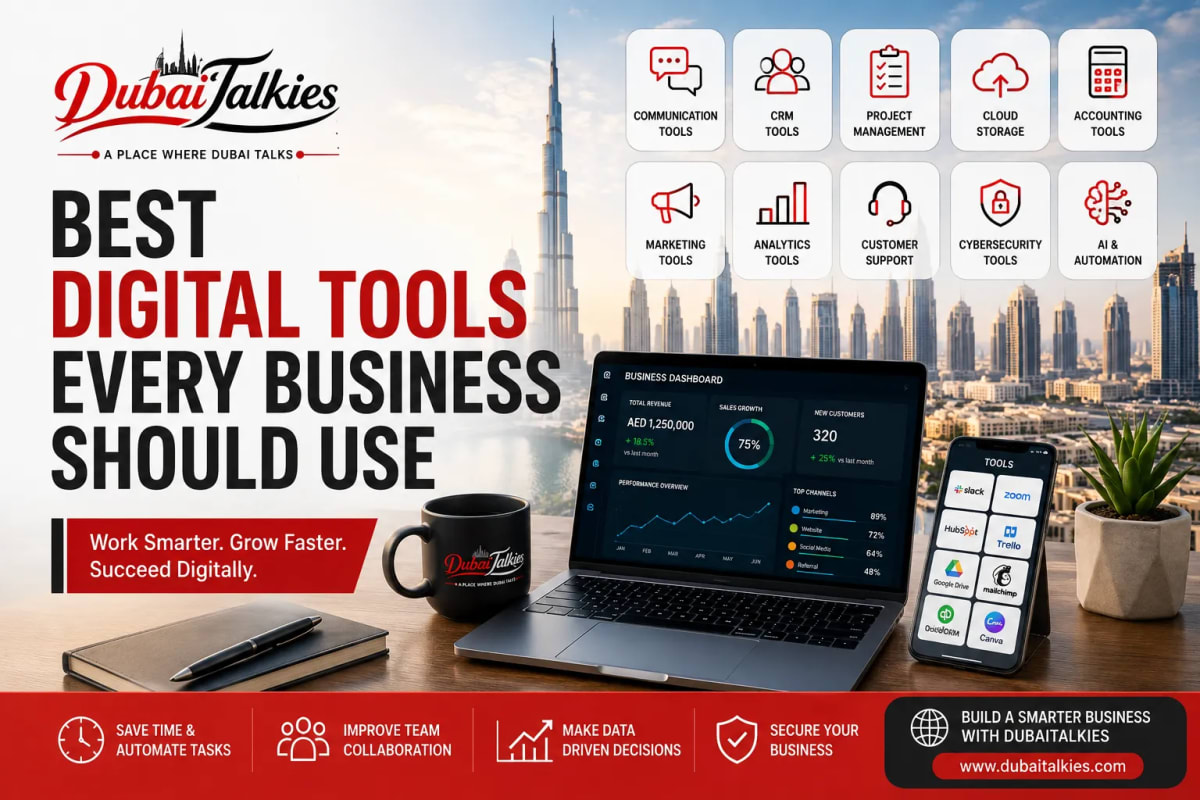
However, most modern businesses should consider having reliable tools for communication, accounting, customer relationship management, project management, cloud storage, marketing, analytics, customer support, cybersecurity and AI-assisted productivity.
The goal should be to create a practical technology ecosystem where each tool has a clear role. Businesses should prioritise reliability and usability over having the largest number of applications.
Digital tools are no longer optional extras for many modern businesses. They can influence how efficiently teams work, how quickly customers receive responses, how accurately financial information is managed and how effectively business owners understand their performance.
The best digital tools every business should use are not necessarily the most expensive or advanced platforms. The right tools are those that solve genuine problems, save time, improve communication and provide useful information for better decisions.
Businesses should begin by identifying their most important operational challenges and then select technology that addresses those challenges. As the company grows, its digital systems can also evolve.
Choosing the right technology is only one part of building a successful business. Professional advice can also help entrepreneurs make better decisions about strategy, operations and growth. Our guide on how to choose the right business consultant in Dubai explains what you should consider before hiring a consultant.
For businesses operating in Dubai, digital transformation can provide another important advantage: stronger online visibility. A business may offer excellent products or services, but customers still need to discover it before they can become customers.
This is where Dubaitalkies can support businesses by providing a Dubai-focused digital business discovery platform where companies can showcase their business, products and services and make their online presence easier for potential customers to discover.
Technology can help a business work smarter internally, while a strong digital presence can help it become more visible externally. Combining both can create a stronger foundation for sustainable business growth in 2026.
The most important categories generally include CRM, accounting, communication, project management, cloud storage, marketing, analytics, cybersecurity and AI productivity tools. The exact combination depends on the company's size, industry and objectives.
Yes. Small businesses can benefit from digital tools because they can automate repetitive tasks, improve organisation and reduce the amount of manual work required. However, small businesses should start with essential tools rather than purchasing too many platforms.
Digital tools can improve productivity, customer management, marketing, communication and decision-making. They can also help businesses understand customer behaviour and identify opportunities for improving sales and operations.
AI tools can assist with research, content creation, customer support, data analysis and repetitive tasks. Businesses should still review AI-generated information and avoid relying on AI without appropriate human oversight.
Businesses should first identify the problem they want to solve and then compare tools based on features, pricing, security, scalability, integrations and ease of use. The best software is one that employees can use consistently and that provides measurable business value.













Comments
No comments yet. Be the first to comment!