
3 Free Reels From Your Existing Video - Creator Trial (Free)
September 16, 2026











© Dubai Talkies. All rights reserved by zubaaly management LLC.
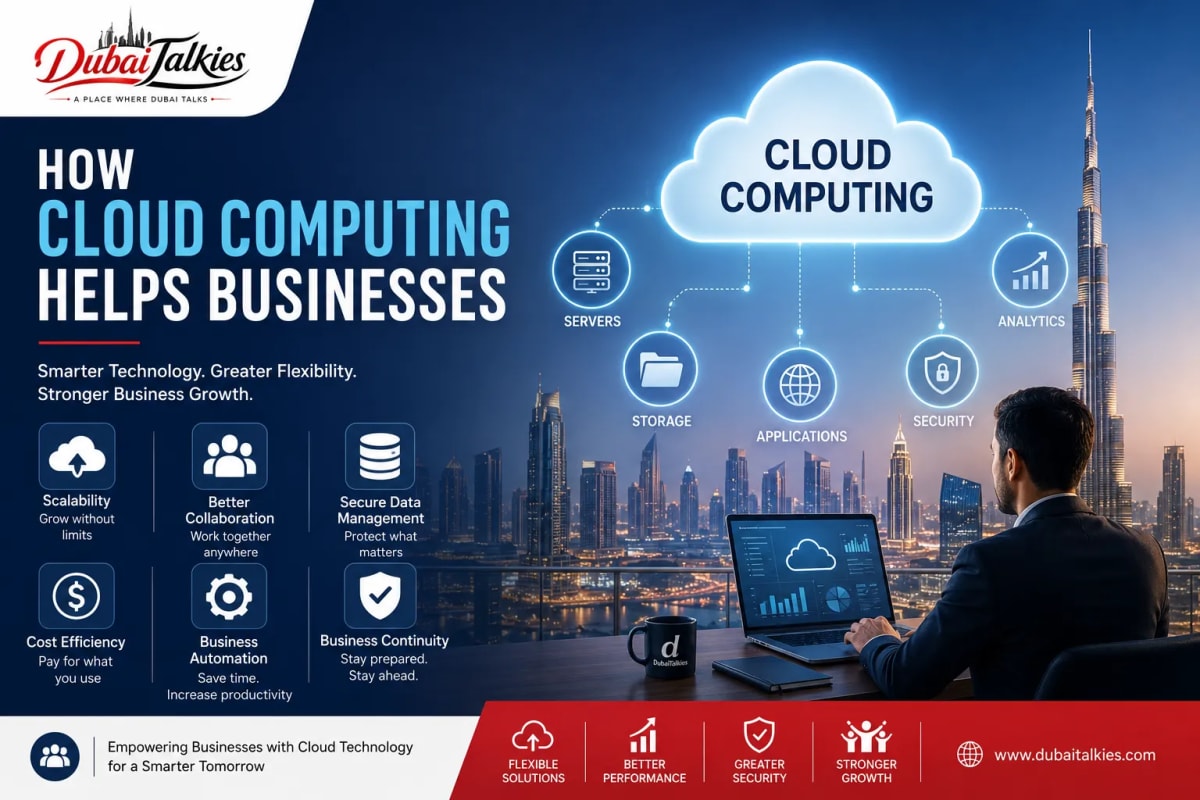
Technology has moved from being a support function to becoming part of the foundation on which modern businesses operate. Customers expect faster responses, employees need access to information from different locations, and companies increasingly depend on digital systems to manage sales, marketing, finance, communication and daily operations.
For many businesses, traditional technology infrastructure can make this difficult. Physical servers require space, maintenance and upgrades. Storage capacity has to be planned in advance. Software can become outdated. Expanding infrastructure can also require significant investment at exactly the time a growing company needs capital for customers, employees and expansion.
Cloud computing offers a different approach.
Instead of relying entirely on technology located inside a company's office, businesses can access computing resources, storage, applications, databases and other services through cloud infrastructure. This can give companies greater flexibility while reducing some of the limitations associated with traditional IT environments.
However, cloud computing is not simply about storing documents online. It can influence how a business operates, collaborates, protects information, serves customers, automates processes and prepares for growth.
For companies operating in Dubai's competitive business environment, understanding these possibilities can help decision-makers determine where cloud technology can create genuine operational value.
Cloud computing allows businesses to access technology resources over the internet rather than depending entirely on infrastructure owned and maintained on-site.
These resources can include computing power, data storage, databases, business applications, analytics platforms and development environments.
The important difference is flexibility.
A business does not necessarily need to purchase physical infrastructure for its maximum future capacity. It can use resources according to its current requirements and increase capacity when its needs change.
This can be especially useful for startups and growing businesses.
A company might begin with a small team and limited data requirements. As customers, employees and transactions increase, its technology requirements can grow as well. Cloud infrastructure can make that transition more manageable.
This flexibility also fits into the broader digital business identity that modern companies are building. A company's technology infrastructure increasingly affects how employees work, how customers interact with it and how efficiently information moves throughout the organisation.
One of the most attractive aspects of cloud computing is the way it can change technology spending.
Traditional IT infrastructure often involves substantial upfront costs. A company may need servers, storage equipment, networking hardware, backup systems and software licences before those systems generate direct business value.
Cloud computing can shift some of these expenses towards an ongoing service model.
This does not mean cloud computing is automatically cheaper. Businesses can overspend if they leave unused resources running, choose inappropriate services or fail to monitor consumption.
The advantage comes from flexibility.
Companies can potentially reduce investment in infrastructure that would otherwise sit underused and increase resources when business demand requires them.
For a small company, this can make advanced technology more accessible. For an established organisation, it can provide additional flexibility when modernising older systems.
The objective should therefore not be simply to reduce IT spending. It should be to achieve greater value from technology spending.
Growth can place unexpected pressure on technology systems.
A website receiving a few hundred visitors per day has different requirements from one receiving thousands. A small sales team has different data requirements from a large organisation managing thousands of customer records.
With fixed infrastructure, increasing capacity can involve purchasing new hardware and waiting for it to be installed and configured.
Cloud infrastructure can provide a more flexible alternative.
Businesses can increase resources when demand rises and reduce them when requirements fall, depending on the cloud services they use.
This can be valuable for companies experiencing rapid expansion, seasonal demand or sudden increases in online activity.
Technology can then become more closely aligned with business growth instead of becoming a bottleneck.
For companies already working on business growth strategy, cloud computing can therefore be considered as part of the operational infrastructure needed to support that strategy.
The modern business environment is not always tied to a single office.
Employees may work from different locations. Sales teams may meet customers outside the office. Managers may need to review information while travelling. Companies may also have teams operating across different cities or countries.
Cloud-based systems can allow authorised employees to access business applications and information from different locations.
This can make remote collaboration easier and reduce dependence on files or systems available only through office networks.
Consider a sales representative meeting a potential customer. If the representative can securely access the relevant customer information, proposals and previous interactions from a cloud-based system, the conversation can become more informed.
Similarly, management teams can access business reports without waiting for information to be transferred manually.
Remote access is therefore not simply a convenience. For many businesses, it has become part of maintaining operational continuity.
Business information can become fragmented when employees store documents on individual computers, send multiple versions through email or use disconnected systems.
Cloud-based collaboration can create a shared working environment.
Employees can access common documents, applications and information according to their permissions. This can reduce the confusion caused by multiple file versions and make it easier for teams to coordinate their work.
Marketing, sales, finance, customer service and management teams can all depend on shared information while performing different responsibilities.
Cloud collaboration can also support faster communication between departments.
For example, when a sales team closes a new customer, relevant information can potentially become available to finance, operations and customer service without requiring repeated manual transfers.
The quality of collaboration still depends on the systems and processes a business uses. Cloud technology provides the infrastructure, but companies must design sensible workflows around it.
Data is one of the most important resources modern companies manage.
Customer information, sales records, website activity, marketing results, financial data and operational information can all contribute to business decision-making.
As the amount of information increases, storing and accessing it efficiently becomes more challenging.
Cloud storage and cloud databases can provide scalable environments for managing growing volumes of data.
Businesses can also connect information from different applications to create more useful reporting and analysis.
This can help management understand what is happening across different areas of the company.
For example, marketing data can be compared with sales information to understand which campaigns generate enquiries. Customer data can be analysed to identify recurring behaviour. Operational data can highlight bottlenecks.
The goal is not to collect more data simply because cloud storage makes it possible.
The goal is to make business information more accessible, useful and actionable.
Cloud computing and automation often work together.
Modern businesses increasingly use software to automate repetitive activities such as notifications, lead assignments, reporting, document processing, customer communication and internal approvals.
Cloud-based applications can allow these systems to communicate with one another.
For example, a customer submits an online enquiry. The system can record the information, notify the appropriate employee and trigger a confirmation message.
This reduces the number of manual steps involved in processing the enquiry.
Businesses already researching what is business automation can view cloud infrastructure as one of the technologies that makes these connected workflows possible.
Automation can also reduce repetitive administrative work. Employees can spend more time on customer relationships, strategic decisions and tasks requiring human judgement.
The real benefit is not simply doing things faster. It is creating a more consistent operating process.
Customer expectations have changed significantly.
People want businesses to respond quickly and provide relevant information without repeatedly asking them for the same details.
Cloud-based customer relationship systems can help businesses centralise customer information and make it available to authorised employees.
A sales representative can review previous interactions. A customer service employee can understand an earlier issue. A manager can monitor customer activity.
This creates a more connected experience.
Cloud technology can also support websites, applications, communication platforms and automated customer journeys.
When these systems work together, customers can move more smoothly from discovery to enquiry and eventually to purchase.
This is particularly relevant because customers increasingly research companies before contacting them. Businesses should therefore understand how customers compare businesses before buying and ensure that their technology supports the information and service experience customers expect.
Moving systems to the cloud does not remove the responsibility for protecting business information.
Security needs to be considered throughout the cloud environment.
Businesses should control who can access information, how users authenticate themselves, which applications can communicate with each other and how sensitive information is protected.
Multi-factor authentication, role-based permissions, encryption, monitoring and regular security reviews can all contribute to a stronger security environment.
Businesses should also understand the shared responsibility model used by many cloud providers.
The provider may secure the underlying infrastructure, while the customer remains responsible for areas such as account configuration, user permissions, applications and data.
Companies handling sensitive information should therefore assess their security requirements before beginning a cloud migration.
This becomes particularly important as businesses increasingly depend on connected systems and face a wider range of digital security risks.
Companies evaluating top cybersecurity companies in Dubai 2026 may also consider how cybersecurity expertise can complement their broader cloud strategy.
Unexpected technology problems can interrupt normal operations.
Hardware failures, damaged equipment, accidental deletion, cyber incidents and other disruptions can make important systems unavailable.
Cloud technology can support business continuity by providing options for backups, redundancy and disaster recovery.
However, simply storing information in the cloud does not guarantee complete protection.
Businesses need defined backup policies, recovery procedures and access controls. Critical systems should be tested to determine whether they can actually be restored when required.
A good recovery strategy answers practical questions.
How quickly can the business restore important applications?
Where are backups stored?
Who can access them?
What happens if the primary system becomes unavailable?
Cloud infrastructure can provide important capabilities, but business continuity ultimately depends on planning and implementation.
Flexibility is one of cloud computing's biggest advantages.
A company can potentially launch new applications, increase storage, expand computing capacity or provide access to additional employees without rebuilding its entire physical infrastructure.
This can make experimentation easier.
Businesses can test new digital services and processes without necessarily making the same infrastructure investment required under a traditional model.
Flexibility can also help companies respond to changing market conditions.
If customer demand changes, the technology environment can be adjusted accordingly.
This is particularly relevant for businesses pursuing digital transformation companies and services because transformation requires technology environments that can evolve with business requirements.
Cloud computing can therefore serve as infrastructure for broader modernisation rather than being a standalone technology project.
Artificial intelligence requires computing power, data and suitable technology infrastructure.
Businesses increasingly use AI for customer service, data analysis, marketing, content workflows, forecasting, automation and internal operations.
Cloud platforms can provide access to computing resources needed to develop or run AI-powered applications.
This can be particularly useful for businesses that do not want to build and maintain extensive hardware infrastructure themselves.
AI systems can process large amounts of information, but their effectiveness depends on the quality of the underlying data, applications and business processes.
Companies exploring how AI is changing business operations should therefore consider cloud computing as one of the infrastructure layers supporting the broader AI ecosystem.
The combination of cloud technology, automation and artificial intelligence can help businesses develop more connected and efficient workflows.
Businesses often rely on several major systems to manage operations.
Enterprise resource planning systems can support areas such as finance, procurement, inventory and operations. Customer relationship management systems focus more heavily on customer interactions, sales and service.
These platforms can increasingly operate through cloud environments.
This can make it easier for authorised employees to access systems from different locations and can support integration between applications.
However, businesses should carefully evaluate how different systems work together before adopting them.
Companies researching ERP vs CRM which is better for Dubai businesses in 2026 should remember that ERP and CRM systems solve different business problems. In many cases, they can complement each other rather than represent an either-or decision.
Cloud infrastructure can provide a common technology environment in which these systems operate and exchange information.
Cloud computing is not only for large enterprises.
Small businesses can benefit because they may not have the budget or technical staff required to build extensive internal IT infrastructure.
Instead of purchasing large amounts of hardware at the beginning, a smaller company can use cloud-based applications and infrastructure according to its needs.
This can help startups focus limited resources on customers, products and growth.
Cloud services can also support professional operations from an early stage.
Employees can use collaborative applications, customer management systems, online storage, accounting platforms and communication tools without requiring a large physical technology environment.
As the business grows, technology resources can be expanded.
The important point is to avoid adopting technology simply because it is available. Small businesses should select services that solve real operational problems.
Cloud migration should begin with an assessment rather than a technology purchase.
Businesses should understand their existing systems, data, applications, employees and operational requirements.
Some applications may be straightforward to migrate. Others may require redesign or integration work.
Security and compliance should also be reviewed before sensitive information is moved.
Costs need to be considered carefully as well. Businesses should estimate both migration costs and ongoing cloud usage.
Employee training is another important factor.
A technically successful migration can still fail if employees do not understand how to use the new systems correctly.
A practical cloud strategy should therefore consider technology, people, processes, security and costs together.
Digital transformation is about changing how a business uses technology to operate and serve customers.
Cloud computing can provide the flexible infrastructure required for this change.
A company can connect its website, CRM, ERP, analytics, automation, customer communication and other systems through modern cloud environments.
This can reduce dependence on disconnected legacy infrastructure.
It can also create opportunities to redesign inefficient processes.
For example, instead of manually transferring information between departments, businesses can integrate systems so information moves automatically between approved applications.
This can improve operational efficiency while creating a more connected customer experience.
Companies looking at top digital transformation companies in Dubai 2026 should therefore evaluate not only the software being recommended but also how the proposed technology architecture supports long-term business objectives.
A company's digital infrastructure increasingly affects how customers discover and interact with it.
Websites, business profiles, online enquiries, customer databases, analytics and communication systems all contribute to the digital customer journey.
This makes cloud infrastructure relevant to a company's wider online operations.
Businesses working to improve their professional online presence need technology that can reliably support their website, applications, customer interactions and internal processes.
Similarly, companies focused on how businesses can generate high-quality leads online can use connected cloud systems to capture, organise and manage leads after they arrive.
Visibility may create the opportunity, but technology can help businesses manage what happens next.
Dubai has developed a highly competitive business environment where technology increasingly influences how companies operate and compete.
Businesses across professional services, technology, real estate, healthcare, finance, retail and other sectors are adopting digital tools to improve efficiency and customer engagement.
This makes technology infrastructure an increasingly important business consideration.
Companies that rely on outdated systems may eventually face challenges around scalability, collaboration, data management and integration.
Cloud computing can provide an alternative foundation that allows businesses to modernise gradually.
The right solution will differ from one company to another. A small professional firm may need cloud-based productivity and customer management tools, while a larger organisation may require complex infrastructure, data systems and security controls.
The principle remains the same: technology should support the business rather than create unnecessary complexity.
Cloud computing is becoming closely connected with other major technology developments.
Artificial intelligence, automation, analytics, cybersecurity and connected business applications increasingly depend on flexible computing infrastructure.
As these technologies become more accessible, businesses may use cloud environments to build more automated and data-driven operations.
The future will not simply be about moving everything to the cloud.
Companies will need to focus on efficiency, security, integration and business value.
Hybrid environments may remain appropriate for some organisations. Others may rely heavily on public cloud platforms or specialised services.
The most successful approach will depend on the company's size, industry, regulatory requirements, customers and operational objectives.
Cloud computing has changed the way businesses can approach technology.
It can provide flexibility without requiring companies to build every part of their infrastructure themselves. It can support remote work, collaboration, data management, automation, customer service, business continuity and digital transformation.
For startups and smaller companies, cloud services can provide access to useful technology without requiring substantial upfront infrastructure investment. For larger organisations, cloud computing can help modernise legacy systems and connect increasingly complex operations.
But cloud adoption should never be treated as a simple technology upgrade.
Businesses need to understand what they are trying to achieve, which systems need to change, how information will be protected and how ongoing costs will be controlled.
The real advantage comes when cloud technology is connected to a clear business objective.
When the infrastructure, software, data and people work together effectively, cloud computing can become more than an IT solution. It can become part of the foundation that helps a business operate more efficiently, respond faster and prepare for its next stage of growth.
Cloud computing can help businesses improve scalability, remote access, collaboration, data management, automation, customer service and business continuity while providing more flexible access to technology resources.
Yes. Small businesses can use cloud services to access applications, storage and computing resources without necessarily making large investments in physical IT infrastructure.
Cloud computing can reduce certain hardware, maintenance and infrastructure expenses, although the actual savings depend on usage, service selection and effective cost management.
Cloud platforms can provide strong security capabilities, but businesses remain responsible for areas such as user access, authentication, configuration, applications and data protection.
Cloud-based applications can connect different business systems and automate activities such as lead processing, notifications, reporting, customer communication and internal workflows.
Yes. Cloud platforms can provide the computing resources and infrastructure required to run many AI applications, process data and integrate AI into business workflows.
Growing businesses need technology that can adapt to increasing customers, employees, data and transactions. Cloud infrastructure can provide greater flexibility as these requirements change.












Comments
No comments yet. Be the first to comment!